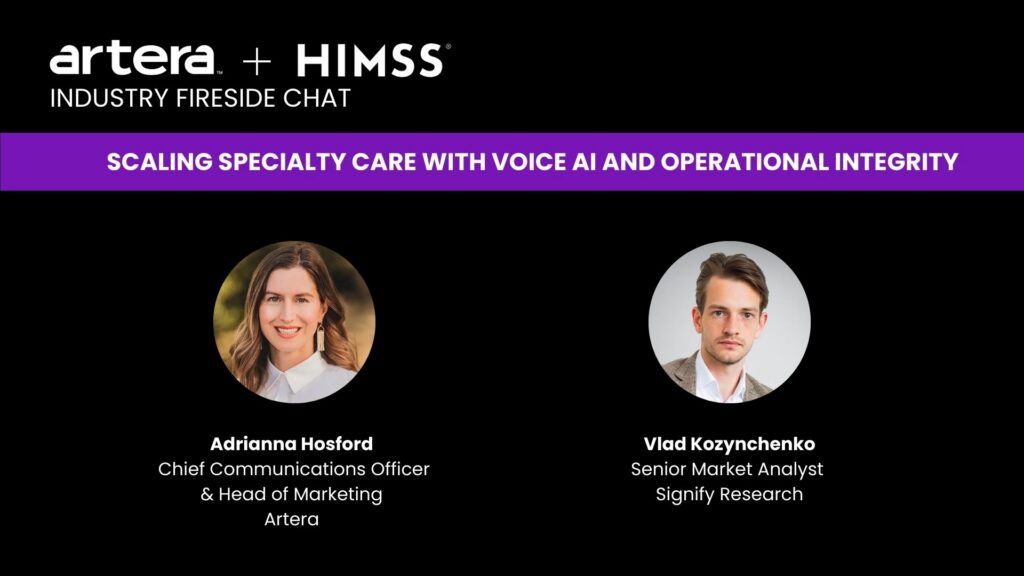
At HIMSS26, Artera hosted a standing-room fireside chat that reframed how specialty practices should be thinking about Voice AI; not as a flashy innovation, but as a structural necessity.
Adrianna Hosford, Chief Communications Officer and Head of Marketing at Artera, sat down with Vlad Kozynchenko, Senior Market Analyst at Signify Research, to share a first look at new primary research that Signify is conducting across U.S. specialty groups. The findings are both timely and clarifying: the specialty care sector is under real operational pressure, and Voice AI is emerging as a critical lever for long-term stability (if it’s implemented correctly).
The Structural Forces Driving Voice AI Adoption
Kozynchenko opened with a grounding point that set the tone for the entire conversation: specialty practices aren’t turning to Voice AI because it’s trendy. They’re doing it because their operating models are under strain. Across interviews with specialty group leaders spanning dermatology, ophthalmology, orthopedics, and multi-specialty practices, four structural pressures surfaced repeatedly: sustained high inbound call volumes, staffing volatility and training burden, growing patient expectations for immediacy, and a crowded vendor landscape where differentiation is hard to assess.
This framing matters because it reorients the conversation. Voice AI isn’t a nice-to-have; it’s a response to a system that is functionally struggling. And the stakes are high: patient access, as both speakers emphasized, is not merely an administrative function. It is directly tied to revenue capture, operational efficiency, and the patient experience.
Patient Access as a Revenue Engine
One of the session’s sharpest insights was the repositioning of patient access from a back-office cost center to a front-line revenue driver. Every unanswered call, every abandoned hold, every missed scheduling opportunity represents lost revenue — and in specialty care, where appointment types are complex and provider-specific rules are the norm, those losses add up fast.
Kozynchenko outlined four measurable performance dimensions that specialty groups are increasingly using to evaluate their access operations: volume and throughput efficiency (how much work is moving through the system), access and conversion outcomes (are calls turning into booked appointments?), responsiveness and service level (how quickly are patients helped?), and experience and quality signals (is trust being built or eroded?). The research finds that Voice AI evaluation is steadily moving beyond “did it reduce workload?” toward “can we attribute measurable lift across all four of these dimensions?” — a shift that has significant implications for how vendors make their case and how operators select them.
The ROI Credibility Ladder: A Framework for Financial Defensibility
Perhaps the most substantive contribution of the session was the introduction of what Signify Research calls the “ROI Credibility Ladder” — a four-stage framework designed to help specialty practices evaluate whether a Voice AI investment is genuinely delivering, or simply appearing to.
The ladder moves through four progressive gates. In the first three months, the question is simply: Is anything moving? Early signals include reductions in call abandonment, early conversion lift, and positive staff feedback. If no visible lift appears, pilots tend to stall. From months three to six, the standard shifts to operational stability — is the integration holding? Are escalations working correctly? Are there complaints? This is where integration errors can erode trust quickly and derail otherwise promising implementations.
By months six to twelve, the scrutiny becomes financial: can leadership defend this investment at the board level? Signify Research frames this as the “financial defensibility” gate — staffing impact needs to be quantified, cost savings validated against total cost of ownership, and the ROI narrative made airtight. The final stage, reached at twelve months and beyond, is strategic sustainability: is Voice AI structurally improving the operating model, or beginning to degrade? Performance volatility or reporting gaps at this stage can trigger wholesale reassessment.
The ladder is a practical tool precisely because it acknowledges that AI investments don’t succeed or fail at a single moment — they move through predictable proof points, and failure to clear each gate has identifiable root causes.
The Integration Challenge: Layering AI Into Complex Infrastructure
Hosford and Kozynchenko also addressed a challenge that doesn’t get enough airtime in vendor conversations: the complexity of integrating Voice AI into the layered access infrastructure that already exists in most specialty practices. Most practices aren’t replacing their telephony, EHR scheduling, or digital communication tools — they’re adding AI on top of them. That layering creates four structural risks: whether the AI reflects real-time scheduling templates and provider-specific rules (integration truth), whether complex or clinical scenarios are handed off safely (escalation integrity), whether human and AI metrics are unified into a coherent operational view (reporting coherence), and whether measurable lift can actually be isolated and defended across channels (attribution clarity).
This is the kind of operational nuance that gets lost in high-level vendor pitches — and it’s exactly the kind of analysis that makes the Signify Research findings valuable for practitioners trying to make informed decisions.
What Comes Next
The session closed with a preview of what the full report will include: deeper specialty segmentation, detailed KPI frameworks, buyer persona breakdowns, a vendor evaluation checklist, and comparative deployment models.
For specialty practices navigating the Voice AI market, the message from this session was clear: the question is no longer whether to adopt Voice AI, but whether your organization has the framework to evaluate, implement, and sustain it in a way that delivers real operational and financial value. The ROI Credibility Ladder offers a rigorous starting point, and the full Signify Research report will offer the data to back it up.
To receive the full Signify Research report on Voice AI for Patient Access in Specialty Practices when it publishes, contact Artera or reach out to Vlad Kozynchenko at [email protected].