The healthcare industry is standing at the precipice of a new frontier: the agentic era. As patient expectations for instant, seamless communication rise, healthcare organizations are increasingly turning to AI agents for patient communications and voice AI for healthcare to bridge the gap between overwhelmed staff and patient needs.
At Artera, our mission has always been to make healthcare #1 in customer service. To achieve this, we’re harmonizing the full life cycle of patient interactions through Artera Harmony, an intuitive patient communication platform that helps providers connect with patients at the right time and via the right modality. For years, we’ve been weaving AI into our product – with our latest evolution being our autonomous AI Agents.
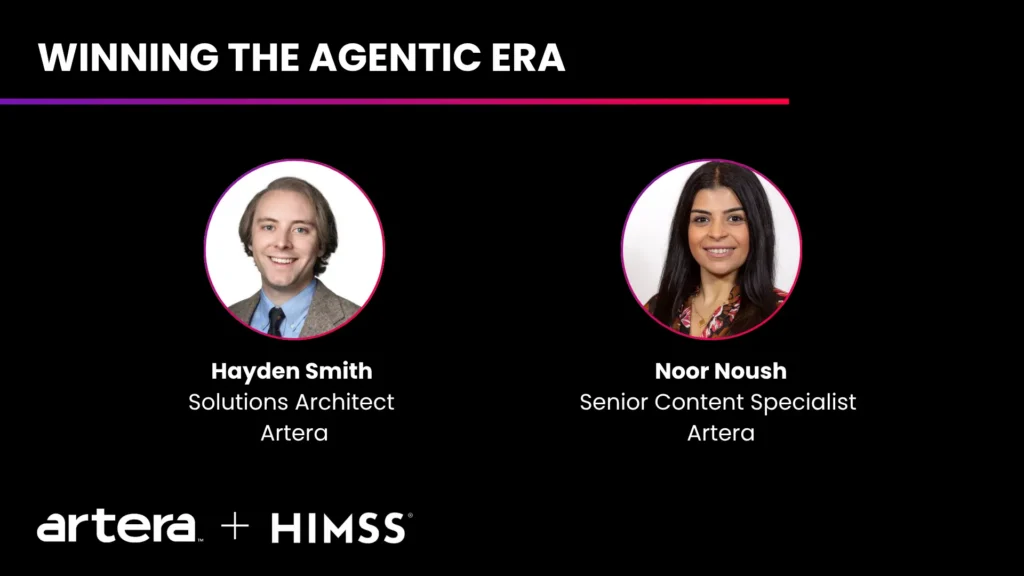
At HIMSS26, Artera colleagues Noor Noush, Senior Content Specialist, and Hayden Smith, Solutions Architect, discussed the intricacies of AI Agents for patient communications, what this new agentic era entails and how Artera is helping lead the charge in agentic healthcare.
Understanding the Architecture of an AI Agent
Before diving into Artera’s smart approach to AI and AI-powered workflows, it’s essential to understand what defines an AI agent in healthcare. These are autonomous systems designed to streamline workflows and handle multifaceted tasks. Every effective AI agent is built upon five critical layers:
- Knowledge: The foundational data and understanding the agent uses.
- Decisions: The logic and planning algorithms that dictate the next steps.
- Actions: The specific commands and tasks the agent executes.
- Language: The medium through which the agent communicates.
- Authority: The ethical boundaries and defined scope that govern the agent’s behavior.
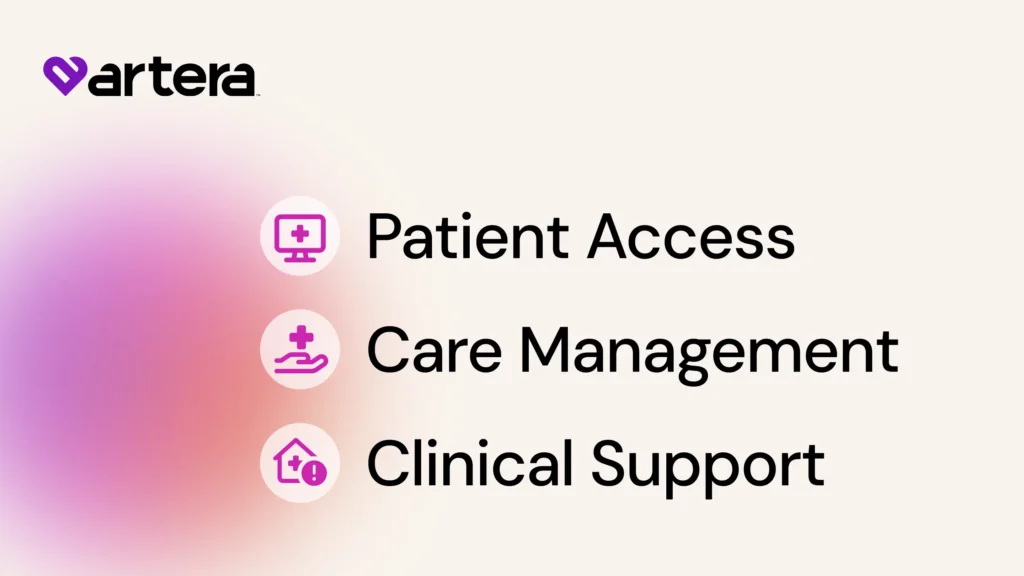
In healthcare today, we believe there are three types of agents being used by providers: administrative & operational (think scheduling patients, billing management, procedure check-in, etc.), ambient voice (medical notes and scribing), and clinical decision support (empowering clinicians to make better decisions).
All of these agents are using advanced technology, with natural language processing and machine learning, and can be integrated within your EHRs. Across the industry, they’re making a huge impact already – improving interactions and boosting operational efficiency.
The peer-reviewed literature backs that up, treating generative AI voice agents as a studied category rather than a speculative one (Source: PubMed Central, ‘How generative AI voice agents will transform medicine.’).
Artera’s Three-Tiered AI Strategy
At Artera, we recognize that every healthcare organization is at a different stage of its AI journey. To support this transition, Artera offers three distinct approaches to patient outreach, primarily supporting your administrative and operational workflows:
- Staff AI Copilot: This “human-in-the-loop” feature assists staff by translating messages, shortening long texts to prevent patient fatigue, and automatically summarizing conversations for EMR insertion.
- Conversation Flows: These intelligent, rules-based virtual agents use Natural Language Understanding (NLU) to interpret unstructured patient responses (like a thumbs-up emoji) and navigate multi-step communication pathways.
- Artera AI Agents: The latest evolution of our AI solutions – and the future of our platform. These are fully autonomous digital workers designed to handle complex use cases across both voice and text channels. On the phone, that looks like an AI medical receptionist that books, verifies, and reschedules on its own.
Conversation Flows is a great place to get your feet wet with AI, acting as a stepping stone into AI-powered workflows. The flexibility within this feature enables more complex workflows while layering in AI to drive engagement and boost operational efficiency.
AI Agents allow us to go even further by incorporating that conversational experience into an automated workflow – available for voice and text.
AI Agents in Action: From Voice to Text
The power of agentic AI lies in its ability to eliminate administrative barriers like “phone tag” while maintaining a high-quality patient experience. Artera supports inbound and outbound AI voice agents in healthcare alongside text workflows. Here are a few scenarios to get you thinking about how our AI Agents can be leveraged:
These scenarios are not hypothetical. In one healthcare organization’s weekly AI voice agent report, 1,379 calls ended with the agent completing a real patient action end to end in a single week: 543 appointments booked, 305 rescheduled, 216 cancelled, 251 appointment details verified, and 64 information requests answered, up 4.5% week over week even as total call volume dipped 2.7%. Each completion is an actual transaction written into the scheduling system, not an inferred outcome: booked means the agent wrote a new appointment into the scheduling system, and verified means it confirmed provider, time, and location without a change.
1. Outbound Voice Agents: Ensuring Procedure Compliance
Consider a patient scheduled for a colonoscopy. Automated patient outreach calls shine here: an Artera voice agent can call the patient to verify their identity, confirm the appointment, and provide a summary of their “prep pack”. By integrating a custom knowledge base, the agent can answer specific questions, such as which liquids are allowed or when to stop multivitamins, without ever needing a human to pick up the phone. That is AI patient call automation working as designed: the routine call absorbed, staff untouched.
2. SMS Agents: Seamless Self-Service Rescheduling
For transactional tasks, text is often the preferred channel. Artera’s SMS agents integrate directly with practice management systems to allow patients to verify their identity and reschedule appointments in real-time. Patients can view available slots and confirm a new time within seconds, all without waiting on hold or navigating a complex portal.
Trust and Quality: The “LLM as Judge”
We know that relinquishing control to AI can be daunting. That’s why Artera utilizes the “LLM as Judge“ concept. Before any agent goes live, we use a separate Large Language Model to run simulations, acting as a patient, to ensure the agent achieves the desired outcomes, such as reducing call volume or increasing care plan compliance.
Even after deployment, we maintain a “human-in-the-loop” approach. For voice calls, we support warm transfers to live staff if a patient’s needs move beyond what a healthcare voice AI assistant should handle, ensuring patients do not have to repeat themselves. For text, we use internal mentions to alert staff when manual intervention is required.
Your Trusted Partner in the Agentic Era
By blending autonomous technology with human oversight, Artera is helping healthcare organizations run AI agents for patient communications that boost efficiency while delivering the personalized, branded experience patients deserve. Beyond the technology, we’re a long-term partner in patient experience, providing the strategic guidance, training, and resources you need to evolve your communication strategy and scale your impact with confidence.
Signify Research specialty voice AI research uncovered that specialty practices, with their high call volumes and complex scheduling rules, see some of the strongest early returns from voice automation.
AI agents for patient communications: operational questions
What happens when a patient’s request moves beyond the agent’s authority mid-call?
For voice, the agent warm-transfers to live staff and passes the full conversation context, so the patient never repeats themselves. For text, internal mentions alert the right staff member inside the same thread. Authority boundaries are defined per workflow before the agent ever handles a patient.
How is agent quality proven before the first live patient call?
Through the LLM as Judge approach: a separate large language model plays the patient across simulated conversations and scores the agent against the outcomes you care about, such as reduced call volume or higher prep compliance. The agent starts taking real calls only after it clears those simulations.
Which EHRs can Artera’s AI Agents write back to in real time?
Artera integrates bidirectionally with Epic, Oracle Cerner, MEDITECH, Athena Health, NextGen, and eClinicalWorks through HL7v2, FHIR, and API connections, so bookings, reschedules, and cancellations land in the scheduling system as real transactions, not notes for staff to re-key.