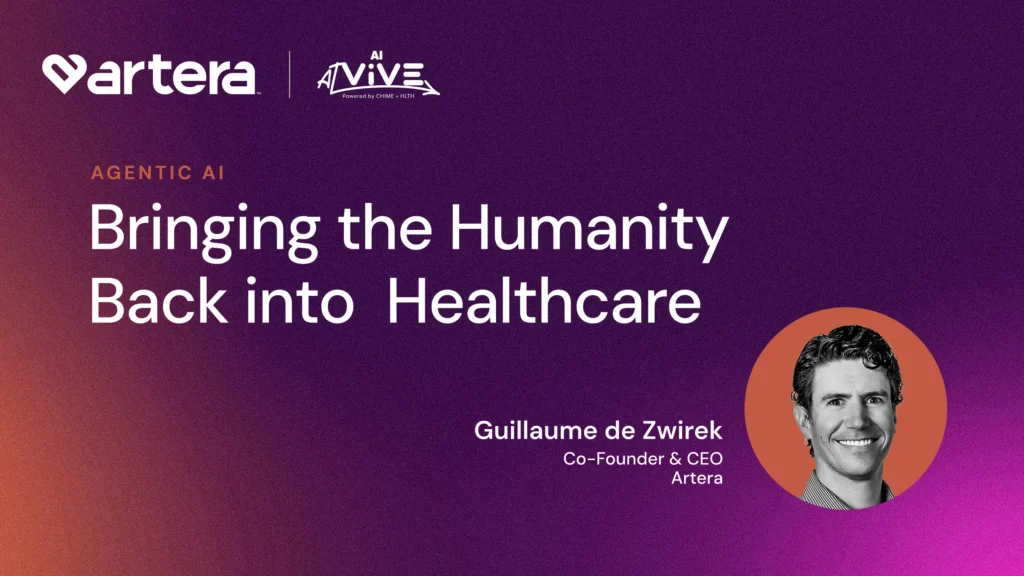
Artera Co-Founder & CEO Guillaume de Zwirek recently joined host Sandy Vance on The AI at ViVE Podcast, published by CHIME and HLTH, for an in-depth discussion about how agentic AI is reshaping the patient experience. His central argument: the agentic era isn’t just a new feature to bolt on – it’s a fundamental shift that has forced Artera to rethink how the company is organized, how its people work, and what its product does.
Drawing on 11+ years in healthcare, 2B+ annual patient communications, and 1,000+ healthcare organizations served, Gui explains why the winners in this era will be the partners who pair a secure agentic platform with the right builders working directly alongside providers.
The conversation covers:
- How Artera has evolved through multiple waves of technology to meet the challenges of patient communication
- The three things Artera had to fundamentally rethink in the LLM era: how it’s organized, how every employee works, and the product itself
- How a security-first posture shapes every decision, and why trust is the foundation of AI in healthcare
- How Artera delivers bespoke, physician-level customization at scale with self-healing systems that monitor engagements 24/7 — and never operate as a black box
Listen to the full episode on Spotify, Apple Podcasts, or HLTH.com.
[SANDY VANCE]
You’ve spent a decade working on the patient experience. What drew you to this problem in the first place?
[GUILLAUME DE ZWIREK]
I looked at the market landscape, and I had no conviction that anybody was going to solve this. I didn’t feel like the right energy was being spent on really understanding why the experience is so broken, and then going to all ends of the earth to fix it. So that’s what we’ve been up to for 10 years — trying to fix that problem. And in an AI era, it has never been a more exciting time to charge forward on this mission, because we can do 10 times more, 10 times quicker now. It is fun to be working on this problem right now.
[SANDY VANCE]
Can we dig a little deeper on what the original problem was, and how those challenges have evolved over the last 10 years?
[GUILLAUME DE ZWIREK]
It starts with a phone. You go to Google, you look for a doctor. My PCP told me I might have had an ocular stroke and needed to see a retinal specialist. They gave me a list of 10 names. I don’t trust them — who should I go see? Back in the day, it was Google. Today it might be an LLM. And then you start calling people, and you hope somebody answers, and you’d better call between 9 and 5, and you’re going to wait on hold, get bounced around to multiple people, and have to explain your condition over and over. It’s a nightmare. And then, all to be told at the end of the day that you can be seen in two months if you’re lucky. When you have an acute healthcare need, two months is not okay. The only answer is: who can I see right now, who I trust?
That’s the problem we saw 10 years ago, and it’s still true today. In some cases it’s worse, because you’ve got folks deploying Wild West agents that aren’t properly integrated and don’t pass security protocols — introducing a lot of risk into the market. And it continues all the way through the point of care: being handed a clipboard to answer questions that are completely irrelevant, or that you’ve already answered 15 times and could have easily been pulled from a medical record somewhere.
The worst part is that the market understood that problem 10 years ago. So what did we do? We took those paper forms and made them digital. And my life got worse. Why? Because with three pages of “do you have this condition, have you had that,” I used to just run a line down the page – no, no, no, flip the page. I can’t do that anymore. Then you wait 15 minutes with no communication, you finally get seen, you’re managing prior auths and referrals, you get your medications and try to understand the dosage and aftercare, and then you get your bill and think, “What is going on? I’m not even clear you billed my insurance. What is a facility fee?” That’s just a sliver of the work that needs to be reimagined.
[SANDY VANCE]
Even those of us who are well versed in the healthcare system are frustrated by it. For anyone who is uneducated about it or marginalized in any way, the disparities in care are enormous. So you founded Artera – what was the first problem you tackled, and how are the platform and services changing this for patients?
[GUILLAUME DE ZWIREK]
We’ve gone through three or four massive technological transformations over the last decade, and I’d argue the most recent one, agentic AI, is the most fundamental. We’ve actually had to rejigger the entire company.
I started the company in 2015 with my co-founder. At the time, the problem started and ended with the phone. I thought, wouldn’t it be nice if this were asynchronous? I don’t want to speak to somebody live. What if I could just text my clinic anytime, 24/7, and they got back to me when it was appropriate? And the FCC had just made a revision to the Telephone Consumer Protection Act — they added a healthcare exigency that allowed covered entities to text their patients for a set of permitted uses. So in 2015 I went, “Ta-da.” Let’s build a web console that’s HIPAA-compliant, connected to the EHR, that lets patients text the 1-800 number on your website and routes it to the right staff member.
That wasn’t automation. My inspiration for founding the company, and my inspiration today, is to bring humanity back into healthcare. This was literally just connecting the amazing staff at these providers with patients, in a channel that made sense to them. That took off, and that was the first wave.
Then customers started calling: “Gui, we love the software, but I’m making really similar calls and sending really similar text messages every day. A patient forgets to pick up their meds; I want to remind them to show up. Can you automate that?” So we looked at events in the database, got that stream of information in real time via HL7, and started triggering outreach automatically. That was the first wave of automation.
The next wave, before agentic work, was the first wave of AI – machine learning with natural language understanding to continue the dialogue. “Hey Sandy, our records show your prescription wasn’t picked up – why not?” Continue the conversation, automate more of it, and hand over to a human when it makes sense. The idea is to free up human capacity, because we have a labor shortage even on the admin and clinical support side. We deployed hundreds of thousands of those workflows.
And then the LLM revolution – that’s where we are today. The thing about these foundation models is they’re not just changing the product you sell. If people still think this is about adding a chatbot to their product, they’re scratching the surface. This latest revolution forced us to rethink three fundamental things.
The first is how we’re organized. Traditional software companies are built to deliver homogeneous software quickly and cheaply, which means protecting engineering time at all costs — layers of client success, implementers, technical project managers, designers, PMs. That’s why when you request a feature, 10 or 100 other customers need to want it, and it takes three months if you’re lucky. That’s not the pace of AI. So the first thing you have to do is flatten the entire organization. We put our builders -we call them builders, not engineers, because anybody can be a builder – directly in front of customers. I manage a 250-person company, and I have three coding sessions running right now while we’re talking.
The second is that our entire company needed to work agentically. That’s not using ChatGPT like a search engine. It’s using your foundation model to do the actual work you used to do. You are now an architect, not a doer – and that’s true for every function: implementation, sales, engineering, and so on.
And the third is the product itself.
[SANDY VANCE]
You’ve mentioned the foundation model a few times. Can you talk about what you mean by that, and how you’ve transformed the company and product?
[GUILLAUME DE ZWIREK]
We blew up the old automation. Sunk-cost fallacy – who cares? It might have cost $3 million to build and generate $30 million in revenue, but that’s not how the world works anymore, and it’s not going to win tomorrow. This is the Netflix moment. We’re fortunate: we’re not a 30,000-person company, and we’re not a two-person startup. We have real market traction, real long-term trusted relationships with our customers, and the audacity to leverage our experience and domain knowledge – around data integration, workflow, the nuances of how physicians book and capture data – to rethink everything and have a bit of amnesia.
When I say foundation model, I’m referring to the big providers – OpenAI, Anthropic, Google, Meta with Llama – that each have these models. We have access to multiple, but a lot of our work happens on Anthropic’s Claude. And here’s a mistake I see a lot of health tech companies make: we operate in a security-first posture. Nothing ships at this company without going through a checklist of security concerns. We hold FedRAMP High, if not the only, then one of very few healthcare IT companies with that designation. It was expensive and took a long time.
When it comes to using an AI model, there are things we weren’t willing to sacrifice. We’re not willing to let Anthropic have that data, and we’re not willing to let them retain it — and neither should our customers be. So we host Claude in Amazon Bedrock, in our own container, with zero data retention. Believe it or not, every employee at this company works out of the terminal. You’d think everyone here was an engineer. They talk to Claude – various models – to do work.
But the foundation model isn’t a search engine. We’ve connected it to all of our tools and resources: Google Workspace, our data pipeline, our meetings – every meeting is recorded because we want our AI to understand what we’re doing and what the customer needs. We run every patient interaction, with human or AI agents, through our pipeline, redact all PHI, and store it securely so our system has access to that information. We started solving things like shared memory. So say you’ve been assigned an orthopedic clinic in Columbus with long phone wait times and frustrated patients, and a competitor next door that has staffed up its call center. Your charge is to get hold time down to five seconds and let patients self-serve. As an Artera employee, you’d start your work in the terminal. You’d describe the situation, and our foundation model, which has access to all of our implementation toolkits – would build a template, provision an account for that customer live, and highlight four other orthopedic clinics that recently had similar challenges. If your client is on eClinicalWorks and cloud-hosted, it knows we have to use a specific integration modality, so you won’t learn that lesson from scratch. We’re using AI to automate the busywork so you can use your best human judgment to understand and solve the customer’s problem. We’re spending about $2 million a year – scaling very quickly – on tokens for internal use alone.
[SANDY VANCE]
Give us an example of a customization that used to be an out-of-the-box deployment but is now fit for, say, a specialty clinic with 250 highly particular physicians.
[GUILLAUME DE ZWIREK]
They want to reduce reliance on their call center and offer self-service workflows, with humans engaging only when there’s a need that requires real nuance. So they want agents, via text and voice, solving problems. Here’s the challenge: it’s a couple hundred physicians, and they’re all very particular. “Someone comes in for this surgery, I need this specific protocol followed.” “I’ll only see knees, but I won’t do bilateral.” “I want workers’ comp, not Medicaid.” The level of specificity for each physician is gargantuan.
In the old days, someone would hand you a big intake form and you’d hire three full-time people to manage all those physician preferences. Today, I can scan the last month of calls your human agents handled, back into the scheduling patterns of every physician – who they like to see, on what days, when, and why – build that into the rule set of our foundation model, and deploy an AI that books precisely the types of patients, at the times and locations, that every one of those physicians wants. So Dr. Sandy gets exactly what you’ve always wanted. You never got that before – you had to adopt what worked for the masses.
[SANDY VANCE]
It sounds fantastic, but even with my background in health data, I have a hard time understanding how you manage scalability with this level of customization.
[GUILLAUME DE ZWIREK]
The answer is more automation. It should be terrifying, but it’s a very solvable problem. We manage hundreds of millions of patients and billions of interactions every year. Multiply Dr. Sandy’s custom preferences and patient Guillaume’s specific workflow across 300 million interactions, and those are the permutations possible every year. You need AI monitoring this. We have systems monitoring every engagement 24/7, identifying the goal of the workflow and where there are deviations.
And to be clear: humans make mistakes too. If your alternative is humans, this is actually far less risky when you deploy it the right way: calling the right APIs so you can’t hallucinate a fake ID, verifying patients correctly. Trust is everything in healthcare. You have to be able to verify, then trust, and trace precisely what happened and why. So we have agents that monitor conversations 24/7, identify adherence to a goal, and recommend improvements. “Hey Sandy, we reviewed 100,000 calls from yesterday, and the number one opportunity to drive more efficiency is automated scheduling of colonoscopies. Thirty percent of patients want them; here’s the actual prompt. We can deploy it to 10% of your traffic, prove there’s no degradation, deploy it automatically, and monitor it 24/7.” It’s self-healing – these systems identify deviations, fix them, and deploy. That’s automation on top of automation.
And what we deliver every day is some of the innovation we’re most proud of. You used to look at dashboards. Instead, we deliver a custom narrative PDF to every physician, explaining exactly what happened with their agents the day before, where patients came from, who booked, who had issues and why, and what opportunities exist to drive more value. Every single physician gets a custom document. If you saw it, you’d think a person spent eight hours on it. We can deliver tens of thousands of those at scale. It’s a whole new world.
[SANDY VANCE]
Let’s talk ROI. What patterns are you seeing in terms of the biggest returns for provider organizations?
[GUILLAUME DE ZWIREK]
It’s somewhat particular. The end solution really does end up feeling bespoke, because it depends on your EHR, your region, your payer mix – so many factors. But the loudest problems are things like getting patients in the door: making sure scheduling is efficient and people are prepared. Then capturing the right information – intake, insurance, demographics – seamlessly. Then the whole prior authorization and referral chain, the billing process, medication management. These are all workflows we’ve solved for. One that was escalated to me yesterday: someone wanted an agent to call payers, so their staff didn’t have to sit on the phone validating things that don’t show up in the payer portals. That’s not hard to build anymore.
The hard thing is building a system that’s scalable, that offers customization at scale, and that gives the customer confidence the problem is being solved really well – and when something is off, they can trace exactly what happened and why. If a complaint comes in, they can query our system: “Walk me through what happened on this call.” And we’ll show them a report – here was the conversation, here was the agent’s reasoning, here’s why it made these decisions, and here are the policies you told us about that it traces back to. It is never a hallucination. Never a black box.
[SANDY VANCE]
There’s a lot of smoke and mirrors right now. How do CIOs separate the companies actually doing this well from the ones that aren’t?
[GUILLAUME DE ZWIREK]
I can only tell you what I know today, because I’d have given you a different answer six months ago. To truly be AI-native at this scale, some foundational things have to be there in healthcare. One is a security-first mindset, and companies should be looking for those flags. It’s not enough to say you’re HITRUST. How do you actually deploy software? How do you run tests? How do you do adversarial security? Nothing should ship without going through the security gates — and that’s not a checklist; it’s a conversation with a security officer where you get to the root of any variance.
The second is what I mentioned: we realized the entire company had to be rejiggered. The best way to suss out whether a company is organized the right way is to figure out how long it takes to deploy software. I was talking to a health system executive who mentioned a vendor that said they could add his use case to their roadmap in three months. He started laughing and said, “I can build this in two hours.” I laughed with him and asked why he didn’t just build it himself. He said, “I have a small team, and I’m doing this for the first time. If I’ve got somebody who can do it quickly, cheaply, and who I trust, I’d rather do it with them.” Then he sent me a markdown file describing the problem, and markdown is the language of LLMs. I smiled, because that’s how problems will get solved in this new generation. It’ll take most of healthcare a little longer to get there, and we need to lead the horse to water.
The third is what you take on as a company. We’re truly not trying to do the commodity stuff. If Google, Amazon, or Microsoft is going to do it, I’m not wasting resources there. We focus all our time on the domain-specific work that provides true, differentiated value in healthcare – understanding the nuances of different specialties, EHR integrations, being in every EHR marketplace, knowing how much those APIs cost and whether they actually work. You’ve seen one HL7 feed, you’ve seen one HL7 feed – people jerry-rig them all the time, and the same is true for APIs. The documentation is wrong. It’s hard, and it’s changing so quickly that this very conversation could be irrelevant in a month.
The underlying tech to deliver an agent is a commodity – I could tell you the service to log onto and you could build a voice or text agent in 20 minutes. Doing that with the right security protocols, at scale, in a self-improving way that works for the nuances of healthcare, connects with the right systems, and improves based on the network of customers – that’s a different story. And it’s not a black box. I’ll sit down with any customer and walk them through the entire stack. If you want to build it yourself, go stitch the pieces together. We’ve built a lot of proprietary, unique things on top of that, plus we have a ton of data, so there are best practices and shared learnings every customer benefits from.
[SANDY VANCE]
How can organizations that want to work with Artera get in touch with you?
[GUILLAUME DE ZWIREK]
Call, email, text – I actually use my phone. Artera.io is our website. If you reach out, our team’s first goal is to understand your problem and your environment and provide a blueprint for how we’d solve it, quickly. We’re impatient people by nature. We’re in the business of the patient experience, so if we’re solving a problem and not solving it better than a human can, we have no business solving it. That’s the promise we believe we bring to our great partners.