Voice AI has moved from novelty to necessity in healthcare. Patients expect to reach you the way they reach everyone else: on their terms, without waiting on hold. The teams answering those calls are stretched thinner than ever.
“Voice AI” isn’t one thing, though. The technology that confirms an appointment does different work than the technology that triages a symptom, and treating them as interchangeable is how good intentions turn into risk. So before you decide where voice AI belongs in your organization, get clear on what kind of work you’re asking it to do.
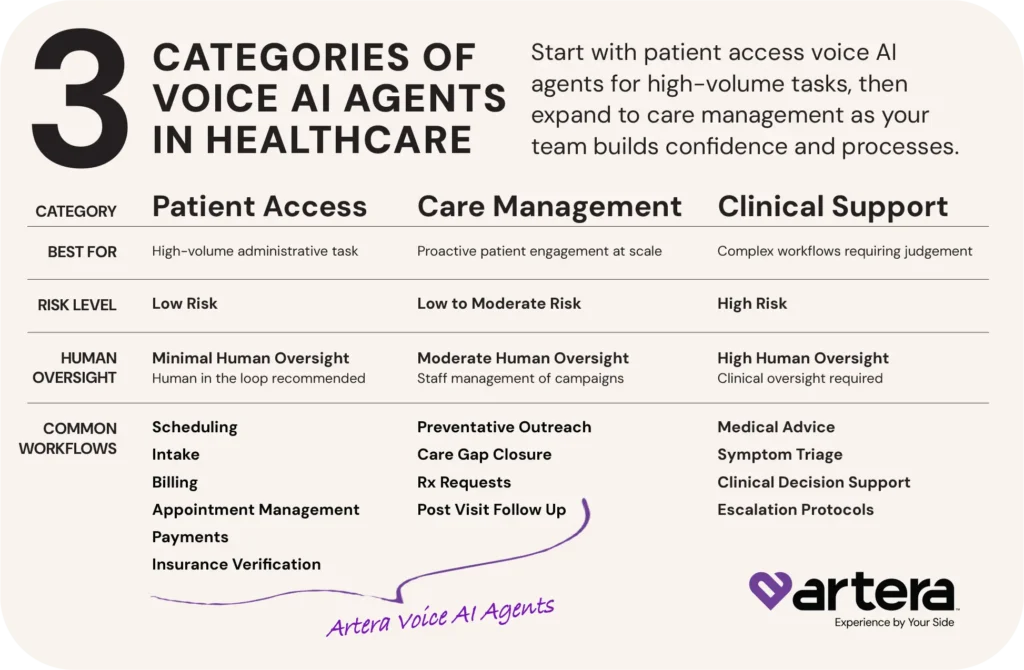
Three categories of voice AI agents in healthcare are worth knowing. What sets them apart is the judgment each task needs and the oversight it demands.
1. Patient Access: high volume, low risk, ready today
Best for: High-volume administrative tasks
Risk level: Low
Human oversight: Minimal, with a human in the loop recommended
This is the front door of your organization, and it’s where the volume lives: scheduling, intake, billing, appointment management, payments, insurance verification. These workflows are structured and repeatable, with clear rules and predictable outcomes. A patient calling to move an appointment doesn’t need clinical judgment. They need a fast, accurate answer at any hour.
The stakes on any single interaction stay low and the paths stay well-defined, so patient access is where voice AI delivers value fastest and at the lowest risk. It absorbs the repetitive call volume that burns out staff, shortens hold times, and frees your team to focus on the patients who need a person.
If you’re starting anywhere, start here.
2. Care Management: proactive engagement at scale
Best for: Proactive patient engagement at scale
Risk level: Low to moderate
Human oversight: Moderate, with staff managing campaigns
Once your team has proven the model on inbound access, you can reach outward. Care management shifts voice AI from reactive to proactive: preventative outreach, care gap closure, prescription requests, post-visit follow-up.
This is engagement at population scale, the kind of consistent, personalized outreach that no team can sustain by hand across thousands of patients. The risk runs a little higher because these conversations touch care rather than logistics, so your staff manages the campaigns and stays close to how they run. The workflows still suit automation well, and the payoff is real: closed care gaps, better adherence, patients who don’t fall through the cracks.
3. Clinical Support: complex work, high judgment, high oversight
Best for: Complex workflows requiring judgment
Risk level: High
Human oversight: High, with clinical oversight required
The third category asks the most: medical advice, symptom triage, clinical decision support, escalation protocols. These workflows demand genuine clinical judgment, carry real consequences, and face the highest standard of scrutiny.
Voice AI can support the people doing this work, and support is the point. Clinical oversight comes first here and shapes the workflow rather than sitting on top of it. You don’t begin here, and you don’t rush. The discipline you build in the first two categories earns you the room to move carefully into harder problems.
The pattern: earn your way up the curve
Look across the three categories, and a progression shows up. As the work grows more complex, the risk climbs, and the human oversight required climbs with it.
That progression is your roadmap. Start with patient access voice AI agents for high-volume tasks, then expand to care management as your team builds confidence and processes. Prove the model where the stakes are low, build the muscle and the guardrails, and let each stage earn the next. Clinical support comes last, after you’ve earned the room to get there.
This is stewardship over speed. You strengthen how your team works rather than replacing the judgment that only people can provide.
| Category | Patient Access | Care Management | Clinical Support |
| Best for | High-volume administrative tasks | Proactive patient engagement at scale | Complex workflows requiring judgment |
| Risk level | Low | Low to moderate | High |
| Human oversight | Minimal — human in the loop recommended | Moderate — staff management of campaigns | High — clinical oversight required |
| Common workflows | Scheduling; Intake; Billing; Appointment Management; Payments; Insurance Verification | Preventative Outreach; Care Gap Closure; Rx Requests; Post-Visit Follow-Up | Medical Advice; Symptom Triage; Clinical Decision Support; Escalation Protocols |
How Artera thinks about the categories of voice AI agents in healthcare
At Artera, we’ve spent more than a decade learning the intricacies of patient experience alongside thousands of healthcare providers. That experience is why we don’t treat every workflow the same.
Artera Harmony is our agentic platform, deploying secure AI agents that solve your most urgent workflows from day one: intake, scheduling, referrals, payments, care gaps, and more, across every channel. Because no two organizations work exactly alike, our AI Service Squads, dedicated teams of Artera’s AI builders, work directly with your team to design solutions that fit your practice, not the other way around.
Security is our baseline, not an afterthought. We meet the highest industry standards: SOC 2 Type 2, HITRUST, HIPAA, and FedRAMP Class D Certification (FedRAMP High). We never use identifiable PHI or PII to train our AI models.
Wherever you are on the curve, from your first scheduling agent to proactive care outreach, Artera is built to meet you there and to grow with you as your needs evolve.