Voice AI is no longer experimental in specialty patient access. Practices across the country are piloting it, deploying it, and planning for it because the pressure to do more with less has made the status quo untenable. Call volume keeps climbing. Front-office staffing stays volatile. Patients expect the same immediacy from their specialist’s office that they get everywhere else. And the vendor landscape has grown so crowded that nearly every solution sounds the same.
So we set out to find specialty leaders a better answer — and commissioned Signify Research, a specialist HealthTech market intelligence firm, to ask the question directly: what actually separates the voice AI deployments that hold from the ones that stall?
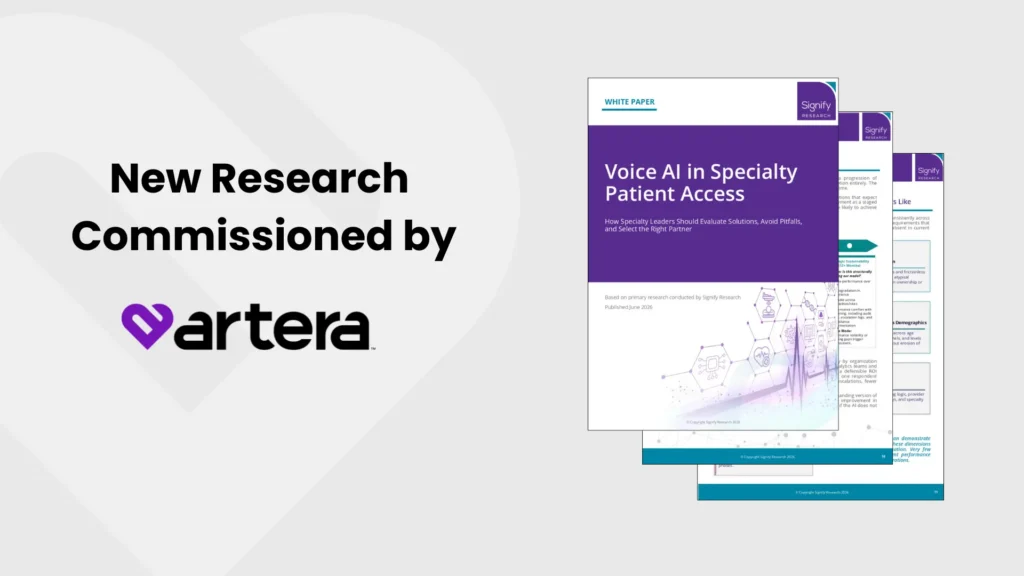
The result is a new report, Voice AI in Specialty Patient Access, built on in-depth, structured interviews with specialty group leaders across dermatology, ophthalmology, orthopedics, and multispecialty organizations. The practices represented range from two locations to 175 sites, and the voices include operations, IT, and C-suite leadership.
We commissioned it to give specialty leaders something the market doesn’t currently offer: a vendor-neutral way to evaluate voice AI effectively – useful whether or not you ever choose to partner with Artera.
Here’s a look at what the research found.
The pressure is structural, not optional
Across every interview, the same four forces surfaced regardless of specialty or size:
Sustained high call volume. Demand has outpaced staff capacity. At one orthopedic practice, only 25–30% of inbound calls were actually scheduling requests; the rest were questions about hours, directions, records, and billing, all consuming staff time without filling a single appointment.
Staffing volatility. Hiring, onboarding, and retaining front-office staff remains one of the most disruptive challenges in specialty access. As one leader put it, unlike staff, an AI system doesn’t need breaks, vacations, or days off.
Rising patient expectations. Patients now compare a call to their specialist with the responsiveness of consumer services, and the gap shows up in satisfaction scores and online reviews.
A crowded, hard-to-read vendor landscape. Most solutions demonstrate well. Fewer hold up in live operations. The difficulty, one operations leader said, is “knowing which ones hold up when 200 calls come in on a Monday morning.”
Underneath all four is a bigger shift: patient access has moved from an administrative function to a strategic one, and is tied directly to revenue, schedule utilization, and patient retention. This means the cost of getting Voice AI evaluation wrong has risen sharply.
Most pilots don’t stall on technology. They stall on evaluation.
The most important finding in the research is also the most counterintuitive. The pilots that stall usually don’t fail because the technology can’t perform. They fail because the criteria used to select the technology were poorly matched to operational reality.
Most solutions look identical on the surface. The differences in EHR integration depth, escalation safety, configuration flexibility, and reporting only become visible after go-live, which is the most expensive possible moment to find them. The research identified five predictable gaps where evaluations go wrong, from the demo problem to integration that’s assumed rather than verified.
The organizations making real progress, the research found, weren’t the fastest movers. They were the most rigorous evaluators.
What the report gives specialty leaders
The report is built to be used, not just read. Inside, specialty leaders will find:
- The four operational forces pushing specialty groups to evaluate Voice AI right now
- Why so many pilots stall after the demo, and the specific gaps that cause it
- The seven dimensions a high-performing Voice AI access model must deliver
- A practical five-step evaluation framework and a vendor checklist you can use today
- How to structure deployment as a staged proof process, the ROI Credibility Ladder, with defensible ROI at every stage
Artera is here to help
Getting Voice AI right isn’t about moving fast. It’s about evaluating well.
As a partner to thousands of providers across the nation, and having spent more than a decade alongside them, we’ve learned that the difference between a vendor and a partner only becomes clear after go-live – when scheduling complexity, EHR integration, and edge cases meet the real world. Giving specialty leaders a trusted, independent tool to evaluate that, even if it leads them somewhere other than Artera, is the most honest expression of how we see our role as partner.
Download the full report to receive your evaluation framework, robust checklist and more: Voice AI in Specialty Patient Access