
Now that you’ve successfully identified your organization’s challenges with patient communications, it’s now time to move on to the next governance best practice: review the current state of patient communications.
Collectively, it’s fair to say most of us believe it’s relatively easy to digitally communicate with patients today. Doing it well, however, is a skill many healthcare organizations are continuing to learn over time.
That being said, it’s extremely challenging to fix what you can’t see – and as organizations redefine their holistic patient engagement strategy, a solid review and documentation of the current state of patient communications become critical to a successful approach.
A review will ultimately help you better understand where you’re at in terms of patient communications and uncover insights necessary to reducing overcommunication and establishing greater patient relationships.
What Reviewing the Current State of Patient Communications Entails
The first step in the review process involves documenting the various departments within your healthcare organization that directly communicate with patients. This could include Call Centers, Clinics, Care/Case Management teams, Ambulatory Surgery units for pre-post operation instructions, Financial Services and more.
Beyond identifying the departments, it’s critical to perform an “environmental scan,” which helps create an inventory all existing technologies and tools used for patient communications. This can be achieved via two ways: collaborating with your IT department to obtain a comprehensive list of messaging tools, or engaging management across functions to contribute a list of patient engagement tools and technologies.
When mapping out your inventory, think about the vendors, use cases, message forms and the effectiveness of your current messaging. This type of inventory not only highlights the many patient communication tools in use but also helps organizations identify communications oversight or integration opportunities.
Key Considerations for Effective Patient Communication
Once you establish a holistic inventory of communication tools and methods, each department should take the time to examine their current communication strategies. This involves reflecting on several questions:
- What systems and tools are we using to communicate with patients? Understanding the technological landscape is foundational to assessing the effectiveness and efficiency of patient communications.
- When are we communicating with patients? Timing can significantly impact the receptiveness and responsiveness of patients.
- How frequently are we sending messages? Identify the days / times you’re messaging your patients. How many messages are they getting a day? A week? Is it too much or too little?
- What communication modes are we using? Whether it’s email, SMS, or call, your communication modes should align with your patient’s preferences.
- What is our target population? Identify the unique characteristics of a population and then tailor content to that – this can improve engagement and outcomes.
Focus on Value, Not Volume
Despite high expectations to digitally communicate with patients frequently, health systems should be focused on delivering value rather than volume when it comes to patient communications, according to Meg Aranow, SVP, Platform Evangelist at Artera.
“Today, healthcare providers are expected to digitally engage patients in a more meaningful way and about more than just appointment reminders, including pre-visit preparation, post-visit follow-up care, and prescription refills. This type of digital engagement enables providers to encourage specific behaviors and track tangible outcomes. But as always, more is not always better.”
Meg aranow, svp, platform evangelist, artera
After performing the comprehensive review of the current state of patient communications, you can identify new opportunities to streamline processes, eliminate redundancies and develop a more integrated approach. This could potentially include consolidating patient communication tools, standardizing messaging across departments or implementing new technologies that provide a holistic view of all communications going out to your patients to reduce overcommunication.
Moving Forward in Governance
By conducting a thorough review of the current state of patient communications and adopting a strategic approach focused on delivering value, you are closer to developing a sound governance structure at your organization, which can enhance patient engagement, improve health outcomes, and ultimately, foster a more patient-centric healthcare ecosystem.
Stay tuned for our next blog on patient communications governance, highlighting the third best practice: Establish a Patient Communications Governance Committee.
Continue Your Governance Journey Today
Ready to continue your healthcare communications governance journey?
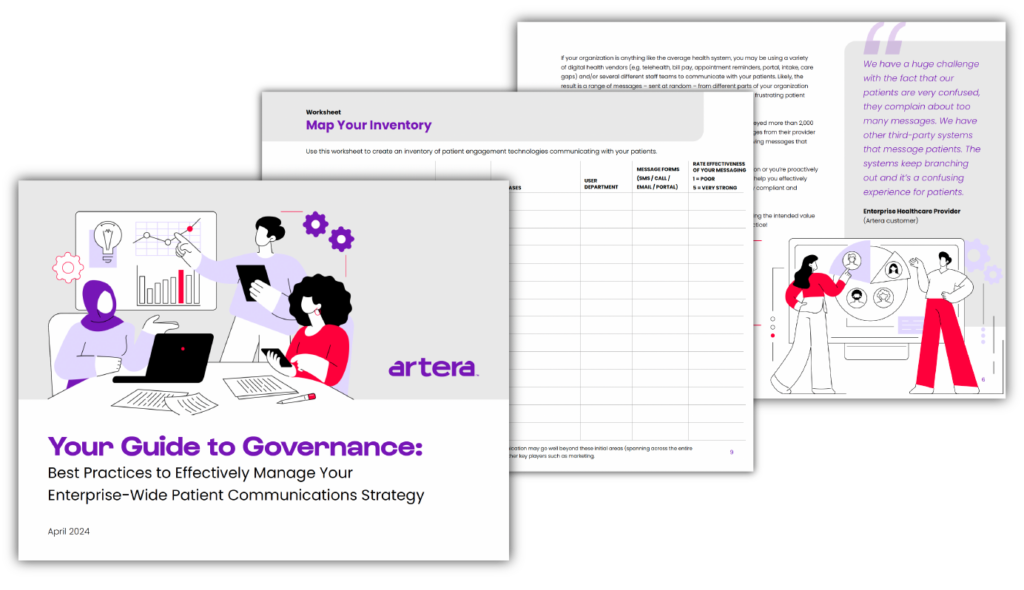
Check out our latest resource “Your Guide to Governance“ to discover five best practices to effectively manage and optimize your enterprise-wide patient communications strategy.