Chrissy: Hi, everybody. Welcome back to Lifers. We have a huge question that we’re tackling today, which is how to operationalize AI. How do teams need to transform? How do customer relationships transform? And then a bigger, more fundamental question of what is AI? Is it software? Is it services? Is it something else?
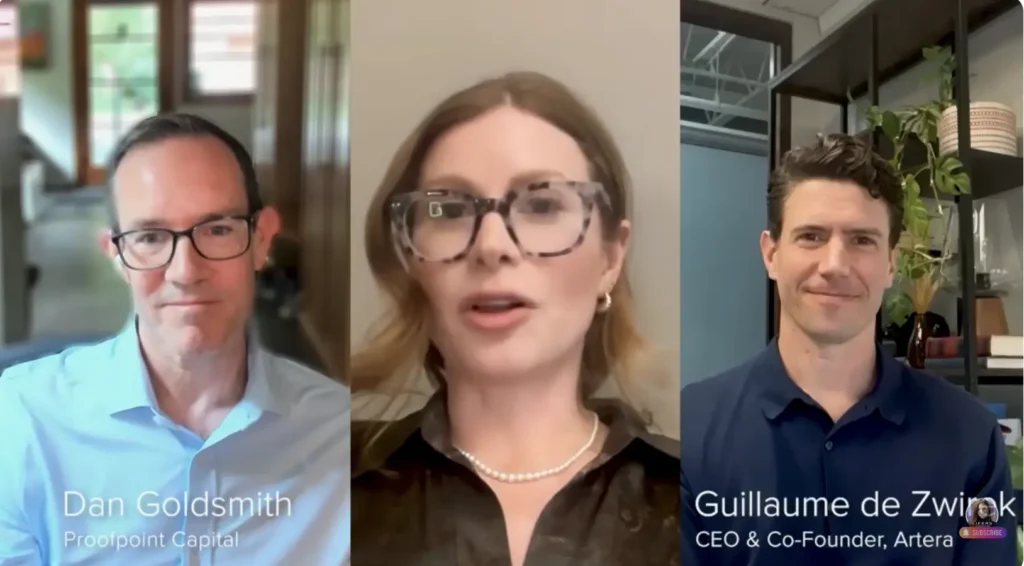
So to discuss these questions and more today, we have Guillaume de Zwirek, who’s the co-founder and CEO at Artera, and we have his board member, Dan Goldsmith, who’s a partner at Proofpoint Capital and a longtime operator. Welcome to the show.
Gui: Thanks.
Chrissy: All right. Well, let’s get straight into it. I’m gonna ask you both this question of what is AI? Because to me, that’s such a foundational question, and it’s rarely discussed. Do you view AI as just like software as a service or SaaS, or do you see it as something else? Is it services? What is it? I’m gonna start with you, Guillaume, Gui, and then we’ll kick the question over to Dan.
Gui: Thanks, Chrissy. What AI is has fundamentally changed probably three times in the last year. I think we’re all figuring this out as time goes. There is no playbook, right? The best you can do is follow what Dario’s doing at Anthropic and borrow the best, but then apply it to something very, very different than a foundation model. I think a year ago, everyone thought that AI was a bolt-on you could put on top of your product and go into hypergrowth.
And then when Claude Code really took the world by storm, AI became a little bit deeper. It became a way of working, right? Using a foundation model, completely changing what the artifact of work is. Initially it was engineers, now it is the entire company, from product marketers to you name it.
And more recently for us, AI is also a complete rethink of how you deliver and solve solutions for your customers. So it is not SaaS in the traditional sense. SaaS is homogenous, right? It’s cheap and it’s quick, but you have to build it for the mass market or whatever the mass is of your end market.
We’re talking healthcare now, so not quite as big as consumer electronics. On the other end, it’s also not consulting, right? These are not big Accenture, Deloitte, long-running, very, very expensive projects. Dan is somebody, by the way, who’s lived on both extremes. To us, kind of our latest viewpoint is that AI is some beautiful combination of services and software. It is delivering bespoke solutions to a customer’s problem at the cost and at the speed of traditional SaaS.
Chrissy: Okay. But to that point, let’s just take it a step further because on the VC side, you told me this company is a SaaS company. This is what I used to do, Dan, and you’ll totally relate to this. So we had a spreadsheet at the previous VC firm that I worked at with a bunch of metrics basically, and we had benchmarked against every single one of these metrics what makes a company a good SaaS company, a mediocre SaaS company, or a bad one across everything from things like NRR and what’s the ACV, which might be like the contract value of the business, and you look at things like retention and all these things.
So we understand at a deep level SaaS, and we know how to value it. Like we can take a revenue of a SaaS business and say, “This is what the valuation should be based on all these metrics.” It’s basically just like financial, right? And then you look at something like services, and there’s been a big question around how should we value services, particularly in healthcare, where it oftentimes involves some kind of interaction between a physician and a patient, right? And then we’re now talking about something completely different, which is some blend of the two meets also consulting. So as a VC, are you just so confused every single day of what these businesses should be valued at?
Dan: You asked about what is AI and now how do VCs think about what businesses are and how do we value businesses? So I’ve been the beneficiary of the last 30 years as an operator seeing many technology paradigm shifts. And if I’ve learned nothing else, the market writ large is long on vision and short on memory, okay?
We constantly look to the future to see things that are very exciting and the potential of what we’re seeing today, but people aren’t talking as much about the patterns we’ve recognized in the past. What I see both as a former operator and now VC is a ton of potential with AI in the market, but it’s not so different from the patterns that we saw when we went from client server to thin client, when we went to the internet, when we went through iterations of mobility and these massive technology paradigm shifts.
And each of these were disruptive to the market and disruptive to various industries, and each of them changed the metrics that we looked at to value companies and understand companies. I’m fairly amused right now to watch the market, frankly, in a tailspin. And the VC and PE markets, as you know, they sort of want everything to look similar. They want everything to look similar and follow a similar pattern. I think the nature of AI, if nothing else, is that the rule book has changed, and there’s not one constant pattern, and the iterations have changed. What AI looks like today is fundamentally different than what it looked like six months ago.
And then on top of that, the way people utilize AI or incorporate it in their daily lives or their business lives is also evolving. I’ve never seen a time in the last 30 years where both the market itself and the evolution of the technology and the pace at which people are learning and adopting have moved in such a parallel motion in such rapid fashion as well.
So I think the entire VC market is confused right now on how do you value a company. The point I’ll make, though, is the fundamentals around companies being durable and enduring have not changed through that period of time. So whether we’re looking at ARR or growth rates or rules of 40, the things that we’ve traditionally looked at, what we can always fall back on is, are these companies durable? Are they adding value? Are they defensible over time? And if they are in this market, I think that you’ll see the winners in this market emerge.
Chrissy: And then to that point, curious from both of you is, you mentioned durability, we’ve mentioned moats. You know, can these businesses survive against competition? Is there something about them that makes these businesses feel like they can stand out? I mean, how do you do that in an era of AI where the models are just developing so quickly? You could be a student of this studying AI all day long and still not be able to keep up with this pace of change that you mentioned, Dan.
So are we just sort of flying blind at this point in time or do you see… Is there some way in which you’re able to assess durability using some of these standards that VCs have always relied upon to value businesses?
Dan: To me, it comes back to the voice of the customer as well. Now, Gui and myself, we focus predominantly on business-oriented markets. So let’s set aside the consumer adoption of AI for a second. Let’s talk business metrics. I’m seeing a lot of false positives in the market right now. I don’t think I’d remember a time where we’ve had companies spin up so quickly and get to a million, five million, 10 million, 20 million in ARR almost overnight.
And for all traditional sense, those should be very attractive companies, and those are companies that look like they are on a trajectory to not just survive, but thrive within this market. There was an article I read recently, a CEO of a healthcare system forwarded it to me, and it was called The Quiet Death of AI in Healthcare, and it was talking about all the companies that started out strong and publicized that strong start and launch into the market but are quietly dying behind the scenes.
So the conundrum we have right now is we’re seeing these companies really take off, but then you have this sort of quiet death. A lot of those false positives are linked to pilots or experimentation. The market and businesses in this market are looking to have an AI story. But when it comes down to twelve months in, eighteen months in, twenty-four months in, the companies that are durable, the companies that have a defensible moat are the ones that can be anchored in the workflow and have demonstrable evidence of delivering value within those companies. I would say eighty percent of the AI companies I look at on a regular basis do not have those two or three factors.
Gui: Well, let’s talk about those high flyers, Dan. I think what’s really interesting and in hindsight the advantage that they have had versus folks that have been around for a while, started in SaaS, is that they benefit from day one of a different way of working. I think most people did not understand this six months ago. AI is not just throwing an LLM on top of your data. The way you work is fundamentally different. And these companies that started a year or two ago, they built their companies different from day one. That secret, that cat is now out of the bag.
We all know how that works, right? We’ve got ninety-seven percent daily active usage of Claude Code at our company, right? Jobs like product and implementation, those are not going to exist into the future. They’re all squeezed together into what people call builders now or FDEs, right? Like the Palantir model.
And that I think was a really well-kept secret for a while, and now the scale players are catching on to that. And I think the advantage, once you’re working in an agentic way that you can bring to bear, is around data, right? If you still have enough of it. Domain expertise, which you can’t really buy your way out of. That takes time. We know that in healthcare. And then the third is distribution. So to me, that was just a really well-kept secret. Cat’s out of the bag. Now the question is how quickly are companies going to embrace that new way of working and make that hundred eighty degree shift to be able to work at the speed and efficiency of these upstarts?
Chrissy: So it sounds like what you’re saying, Gui, if I’m reading you right, is that to be a company that sells AI into markets, whether it be healthcare or any other market, you have to yourself be an AI-first company. You’ve got to reorient the company around AI. And just to kind of peel back some of the layers there, I mean, we’re talking about some fundamental shifts away from, let’s say, management-heavy models. We’re also talking about changes to, you mentioned, PMs and engineers, the old version of the seven-person team, of which it was mostly a mix of PMs and engineers and designers. That seems to be going away. So can you walk us through some examples of how you see within these AI-first companies, how you see fundamental shifts within the way that these orgs even work in a setup?
Gui: With AI-first companies or any company for that purpose, the fundamental goal should be to deliver for your customers. So everything is about how close are you to your customers. In the old day, the most precious resource was engineering time. So to get close to the customer and to deliver for the customer, you had to go through a lot of gates, right? Product, design, implementation, QA. And those gates have all now shrunk because these foundation models can do eighty percent of that work. So if you take a step back and just think customer first, these AI native companies, it’s just, how can I get closer to the customer? Here at Artera, we did a snap reorg of the entire company.
The furthest any builder is away from a customer is one person. We got rid of over fifty percent of management. When I say get rid of, they’ve all been transitioned into builder-type roles. But management has been greatly, greatly reduced. The expectation is that you work agentically. And what I mean by that is nobody is an individual contributor. Everybody works with Claude or drop in any foundation model. That piece doesn’t really matter. So those are two fundamental things that shifted from day one. Our customers, every single customer interfaces directly with a builder now. And the builder might spike on a skill set, right? They might’ve been an engineer growing up. They might’ve been a product manager. They might’ve been an implementation manager. And now Claude, right, in our case, takes care of the eighty percent of the rest. And our challenge now is to retrain our workforce to have enough competency across the three or four disciplines that are required to really deliver on a customer’s problem set, and then obviously bring in new talent as well that just thinks that way because they grew up that way or they started a company from the get-go in that native way.
And we’ve heard the term AI native thrown around for at least a year. I’d say for my company, it wasn’t until four months ago that I think we truly understood what it meant. Everybody’s jobs were blown up.
Chrissy: I think that’s such a fascinating point, and it’s also just that you did the snap reorg, which shows real commitment to building that kind of organization. Dan, I think you’re in many ways, like you can relate closely to the customer because you’re getting pitched nonstop all these companies that want money from you that say, “We’re AI first,” similarly to that customer who’s getting the same pitches. So can you share a little bit more about how you are diligencing the companies on the other side to assess, are you truly AI native? And tell us what you think customers, specifically healthcare customers, should be thinking about as they run their own diligence processes.
Dan: As we look at companies and we think about companies that claim to be AI native or AI-enabled, and then we reflect on how the market and customers view those companies, it’s very different than we thought of in the past. Let’s just start with some basic fundamentals first around what AI can do and what AI native means from a market perspective. First of all, when dealing with a lot of these business-oriented markets, like a healthcare market, which is a vertical market, we do not believe, I do not believe that it is the number of lines of code nor the amount of money a company raises that will make that company successful.
And in fact, that’s never really been the case with vertical markets. If you look at the very successful company in verticals, it’s been they’ve built trust, they’ve built knowledge in that vertical, they’ve built distribution in that vertical, and they’ve had proof. And so if you go back to those fundamentals that have been there in vertical for a long time and then apply them to this AI native lens, you start to take away some of the low-hanging fruit obstacles that would tend to be there.
So, for example, companies for a long, long time would talk about the cost of tech debt. In a world of AI and being native AI, there is no such thing as tech debt anymore. We used to talk about things like the engineering team having institutional knowledge, and if they leave the company, that walks out the door. Well, I had a really interesting conversation with the former CTO of eBay the other day. Not only does tech debt not exist, but I have full context and history of all of my development being native AI, that’s retained within the company. So now if engineers walk out the door, guess what? We’ve retained entire context.
When you think about code being modernized or technology being modernized, it’s no longer an issue anymore. AI takes care of that. So when you start peeling back these traditional impediments to advancing technology and capabilities, you start to remove these obstacles, and what it leaves you with are the things that the market and customers are looking for.
And especially when it comes to healthcare, and I wanna add an extra thing on top of healthcare. What customers are looking for is they want people to understand what they’re doing and the value that needs to be created. Two is they wanna understand that the companies that are pitching to them or promoting to them understand the liability and risk that they incur within their business processes. The third is they wanna understand that there’s gonna be deep connectivity within their ecosystem. So there’s a plethora of, quote-unquote, “AI-native tools” that are coming to the market, but if they’re all on these little islands and they don’t inherently talk to each other, then you’re actually creating more chaos and complexity than good within these environments.
And then a lot of what we talk about within my organization, we talk about with customers, is this idea of sort of risk, or we call it stakes, and then trust and traceability. So what we’ve recognized with AI is the higher the stakes in a workflow or a process or a solution, the more it has to be reliable and scalable and repeatable and trustworthy, which means it needs to perform as you would predict it to perform. You need to have traceability to the evidence underneath anything the solution is doing, and it needs to be reliable. Because if I’m working on creating a presentation or a document and it hallucinates 20% of the time, that’s fine. In aggregate, I am for the better. But if I’m dealing with a medical claim, a medical diagnosis or a patient, and it hallucinates 1% of the time, that company is dead. So it’s just fundamentally different, especially in healthcare, and what companies need to think about and what their customers care about.
Chrissy: Yeah, it reminds me a little bit, actually, today I was having lunch with a benefits leader at a very large company that you both know, and we were talking about the need that she has to query the data warehouse, specifically from a claims perspective. We were talking about AI, and I said, “Why doesn’t the team just build this internally? You can all use the existing AI tools out there. Your engineers can be wildly extended.” And this person said, “Well, no. I mean, we’re not there yet as an organization. We still rely upon vendors. We will be relying upon vendors for the very near future, if not longer, because for us, it’s just not our number one priority for what we wanna do with our internal resources. It’s not core to what the business does.” And I said, “Okay, that’s a really strong point.” It made me think back to this discussion that we’re having, that in healthcare, I don’t think that we’re entering into an era, at least not in the next five years, where health systems, employers, all these stakeholders, essentially the buying universe, are gonna just insource everything and be building a lot of their own AI, which means they are gonna be relying upon vendors.
But I think, Gui, that’s where you got into this really interesting insight around the builder and that connectivity through the builder on your team to the customer. So can you walk me through, maybe in a more tangible way, how you think about having the team orient to the customer, so you can almost be that in-house team that they dream of having, and also give them that confidence just from a governance standpoint, privacy, security? As Dan mentioned, it’s not that simple in a healthcare context. There are so many steps that you have to walk through just to get comfort on both sides.
Gui: With the possibilities of AI today, to us, the thought of buying off-the-shelf software, implementing it eight weeks later, and waiting six months to get a customization through, is laughable. Like, we just don’t see the future that way. Which is why we made this kind of snap decision to rearchitect the way the company is structured. So to get into specifics, the way that used to look like is a customer would license our software, an implementation team would meet with them, deploy the work, make sure all the integrations were connected, and they’d be stood up with our software, let’s call it six to eight weeks later, which is relatively quick for healthcare. Unacceptable in the AI age. So let me just say that as a starting point.
Naturally, because every healthcare organization is special, and particular doctors have preferences, there are some customization requests. And what would happen is that would get sent to a client success manager, that client success manager would send it to product, product would look if anybody else has requested something similar. They would wait for quarterly planning, at which point it might get scheduled or it might get rejected, at which point it would go to a designer who would implement the plan, write the PRDs, it would go to engineers, and you start doing the math of all these layers. Six months later, if you’re lucky, you got something eighty percent of the way to what you really, truly wanted.
Now, the only difference between the new model and the old model, the main difference, is that there’s like seven layers of people between the problem and the solution. But when engineering time is no longer sacred, and I don’t mean this with any disrespect to engineers, I think this is a great equalizer, a great normalizer, and a traditional software engineering mindset is so critical in the modern age. But when that is equalized, you can go from problem to solution in a tenth of the time it would have taken to go through that people process. So our decision was just to eliminate all those people and put the builders directly in front of the customers. So now you have folks that maybe were classically trained as software engineers meeting directly with customers, asking the question, “What is your biggest pain point? What is your biggest problem?” And they’ll describe crazy custom workflows that they would have never dreamed of solving, right? And our engineers, our builders, right? ‘Cause they now come from multiple domains, can turn around a solution, in some cases in two hours, in a staging environment that they can test.
You can customize, and they don’t even need to customize in the software. This concept of like WYSIWYG UI where everything’s managed and hard-coded and deterministic, that is a tax. That is overhead tax. Now the systems are self-managing. The foundation model manages the systems. It looks for breaking changes. The second part of your question was around security and scalability and all those manners, all those other important artifacts. When you’ve built for scale, which is where I think the large companies will be favored in the long term with AI. You understand the traps that you run into.
HIPAA compliance is a great one, Chrissy, right? Like, you can claim HIPAA compliance, and then the benefit of time, you look back, I’ve been at this for a decade, you look back where you started when you claimed HIPAA compliance, and you go, “I never would claim that again with the benefit of time and what I know. There are so many things that I did not know. I was naive. I was ignorant,” right? So you build all of those guardrails, the QA tests, the security frameworks into these self-learning, reinforcing harnesses around the AI that makes sure that every piece of code that’s written, again by an AI, probably proposed by an AI, goes through all these loops and these checks and is automatically deployed to production to the customer. So it’s a fundamental… I can’t stress how insane it is right now. Every assumption, it has to be rethought.
Chrissy: Who in this organization, now that you’ve shifted more to this services model, this builder and the connectivity to the customer. So in the old days, of that seven-person team that you described, the most highly prized people were definitely the engineers, and amongst the engineers, it was probably the specialists, right? The people that could do very, very specific things. In this new era, who on the team would you most prize, or maybe to put it differently, who are the people on the team that you would be most sad if they told you one day, “Gui, I’m gonna leave and go to this other company”? Like, who are you most sad to lose in this new model?
Gui: In this new AI model, the sacred cows are the people that can talk to customers and have an entrepreneurial mindset. People who can talk to customers and immediately solve problems. You need to be able to use an agentic platform, an agentic foundation model. It needs to be connected to your systems, and you need to be willing to talk to a customer, hear their pain, and solve for it right away. Those are the sacred cows. Like, this era rewards the entrepreneurial spirit and mindset over institutional knowledge. Now, you also have to have critical thinking. High confidence, low critical thinking is a recipe for failure. But if you are curious and you want to understand a customer’s problems, the ability to solve for them is so much quicker.
And I don’t want it to seem like we’re moving into a services model ’cause it’s not that at all. Like, when we’re solving solutions, we are building software, but the software is different. It lives in your internal organizational memory. Like, you want two other just random anecdotes of AI-native working? One, you record every single call. You don’t take notes anymore. Every single call is recorded. It’s stored in organizational memory. Two, the entire company runs on GitHub. I log in in the morning, I open up a project directory, and I ask Claude, “What did I miss?” And it tells me, like, what was the meeting that was brought up today. I have a digest every single day that scans every single team environment and escalates things to me that I might wanna chime in on. Back to Dan’s point, if an engineer leaves, we know everything they ever worked on. We know every call they were ever on. We know the code that Claude wrote.
We know if a new customer wants to go live with a new feature, I don’t have to rely on Dan Goldsmith knowing what every other customer has ever done. When Claude or again, whenever your agentic model builds that solution, it will scan what you did across a thousand customers. It’ll know the nuances of the EHR and the things that we had to tweak. It knows the contact person to get an escalation approved. Like, it has the benefit of the corpus of knowledge — it is mind-blowing. Like, I tell my company every day, like, amnesia is your best friend. Like, forget about how things worked. If you think it could work, give it a try, and if it works, we’re gonna know because it’s gonna live in the organizational memory, and everyone will benefit.
Chrissy: I mean, even just take this podcast as an example. My husband works at one of the scale players, in an AI team, and it took him about seventy-two hours, but he built this bot that’s specific to my own media company that is just built off the corpus of every single piece of data that the company sits on. And so I’m going to be asking our internal AI, which is nowhere near as sophisticated as what you’re doing, Gui, at Artera, and Dan, some of your companies that you’ve backed, but it’s just basic stuff. But I’m gonna ask, what time of day should I be running this podcast? And the AI is gonna look at every single piece of content that has ever come out and give me a prediction on the time of day, the specific day of the week.
I mean, it’s just crazy what you can do with the data that you’re sitting on, and we’re a tiny media company. To me, it’s like I get so excited thinking about what a healthcare customer could do because the corpus of data that they are sitting on and currently not using. If you’re a health system, you are using such a tiny fraction of the data that you have at your disposal. Dan, do you — I mean, are you in agreement, in alignment here that this could be absolutely revolutionary for a lot of these healthcare organizations?
Dan: It can be revolutionary. So if you think about the market and how they’re reacting to AI, and let’s talk specifically about healthcare as well. Well, let’s start with the market, and Gui said two very important things. He said, “Builders, not engineers.” He said, “Solutions, not software.” So let’s be really clear that that is where the market is moving and has moved, and if you’re still in an engineering and software mindset, then you’re gonna be left in the dust.
There’s lots of people, I’m sure you all have heard this, saying software is dead. By the way, software is not dead. It’s just that customers are looking for solutions. The analogy I use sometimes, the music industry. Used to buy CDs and cassette tapes, and then we went to downloading MP3s, and we had this idea of ownership in media. But now we subscribe to Spotify. I don’t think about licensing Spotify software to listen to music, but it’s a very personalized experience to me. We in the business realm with solutions, that is exactly what the solution mindset is in this market.
Chrissy: Well, your point, personalization, I think is so apropos here. Like, you might be on Spotify, Dan. If I got rid of your Spotify account and dropped you into Apple Music tomorrow, you would lose your mind. All your preferences. Like, and it’s not even, like, your stored playlist, it’s the AI recommendations of, it’s all your listening. That is the data.
Gui: It is bespoke, it is personalized. Now, Spotify doesn’t have builders meeting with you once a week and asking for your latest, greatest problems, but they effectively have built that in their agents. And that is the software that’s being built. It is these agents that self-learn and self-correct and self-triage new features. Like, builders will just be overseeing agents in the future. We are really not that far from that.
Dan: I think the challenge is when we look at healthcare, is all of these advances will be flooding into healthcare and the opportunities will be there. But there’s a few structural challenges that exist with healthcare in particular. Obviously, you’re dealing with regulations, but you’re also dealing with unions and other impediments to healthcare as well. I know for a fact there’s already legislation or other policies being passed that you’re not allowed to implement certain types of AI or AI capabilities unless the unions approve it, right? And that’s a hotly debated topic. There’s certain restrictions on what big players in healthcare may or may not allow.
Definitely the elephant in the room here. We haven’t touched on that business. I mean, it is an epically large problem that we’re gonna be dealing with here moving forward, in terms of how does innovation flow into the market in healthcare with the opportunities that we have there to advance patient health, to advance outcomes, to improve quality. Which, if you stand back and think about it rationally, everyone talks about the shortage of healthcare resources in just about every corner of healthcare today, yet we’re also concerned about the way AI may create efficiencies in healthcare and disrupt jobs and job availability. Those two things are at conflict with each other. And so how do we reconcile a shortage of resources in healthcare with the impediments to implementing what could be a significant benefit?
By the way, I believe, and I still hope, that AI can put patients back at the center in healthcare and give patients true agency in healthcare that is in partnership with the providers. I think that equation alone can fundamentally transform healthcare in this country and result in better quality, better outcomes, and better access, and better economics. But that’s what’s gonna play out over the next five to 10 years with AI in healthcare.
Chrissy: So let’s talk about some of the actual workflow pieces that you mentioned, Gui. And I’ve got friends who work at some of the big AI companies like OpenAI and Anthropic. You talked about Claude. And certainly prompt engineering. The most adept people when it comes to AI in these early years are most likely the engineers and the PMs, and they are the ones that will spin up some of the most sophisticated uses of these agentic technologies.
Physicians, certainly some of my physician friends are doing it, and many of them are also engineers. There’s this weird, surprising overlap between engineering and medicine. But a lot of them, you just have to make it super easy for them to be able to kind of give you the feedback, to be able to train the models to meet… And you mentioned personalization, to improve based on what their preferences are. So can you walk me through how you’ve been able to work with existing customers on some of these questions where maybe they don’t have the time to sort of give you a call and walk you through all the changes they want to make or maybe don’t have the technical sophistication, and then within one organization, some may be way more comfortable than others? So how have you cracked some of these challenges?
Gui: So on the topic of customization, the first thing I’ll say is this is uncharted territory. There is not a playbook for how to do this well. So all I can share is the things that we’ve learned and we’ve tried that make us quicker. The status quo that healthcare accepts when there’s a customization request, is measured in months and not hours. So that’s the first thing that we have to completely turn on its head. That cannot continue that way, or you won’t be able to scale as a business kind of delivering this level of personalization.
The second is, if you take a practical use case that used to take a long time to implement, like scheduling, right? The reason scheduling is difficult is because every single physician has preferences on how they want their schedule managed. And physicians, especially the high-ticket physicians that are bringing in beaucoup bucks for the health system, right, cardiologists, oncologists, things of that nature —
Chrissy: Beaucoup bucks is the most French American or French Canadian phrase I’ve ever heard. I love it.
Gui: Well, apparently I do have some Canadian. But physicians do not wanna be told how to manage their days, even when they are employed by a health system, right? So the reason scheduling was so difficult is because you had to elicit the inputs of every single physician, and then you had to manage those changes and customization over time. And usually, that was done with a workbook. “Chrissy, here’s a three hundred page spreadsheet. Project manager, go track down every single physician, have them fill out this survey,” then you gotta manage the change orders over time.
Let me walk you through an agentic version of that implementation. Deploy your agent, go back and look at three months worth of scheduling data and back into the rule set that every physician has. It’s in the data, right? I know that Dr. Goldsmith doesn’t see patients on Tuesday mornings. I don’t know why, but he doesn’t see patients on Tuesday mornings. For some odd reason, he always seems to have surgeries on Thursdays. But the data leads me to believe that he only ever does one body part. He won’t do two body parts. So we can actually back into ninety-eight percent of the rule set and then give the completed book to the physicians to validate or edit. So if you think about that shift in burden now, AI has taken the vast majority of the burden, and I’m asking Dr. Goldsmith to give just a short approval or short modification.
So every single workflow is being rethought that way when we need human intervention. The other thing that’s really exciting that’s going on in the background is this idea of harnesses that you build around the agent. So let’s say we deploy an agent that engages patients when they’re about to run out of a prescription medicine, and they need to be seen in clinic to get that prescription renewed. I’m making this up on the fly. When that agent is deployed, you build a harness, and you monitor all the conversations that are happening with patients in real time. You detect anomalies, you judge those conversations. You have an AI recommend actual edits to the prompt, edits to the integration. You run those through an automated QA system, right? And the QA will be like a thousand synthetic patients that call an agent and engage in that conversation. When that passes all of that QA, you graduate it to production, and you monitor, so you can regress or you can improve. So these are systems that are truly self-improving now. So when you layer in, like, the machine is making itself better, you’ve got more time to speak to customers.
Chrissy: If you can build the intake on your own and take all that burden away from the customer, all of a sudden, that physician doesn’t have enough time, maybe doesn’t know enough about how AI works and doesn’t think about all the edge cases they might have considered, you’re handing them the answer key, and you’re letting them make edits. So the burden of work shifts completely from the customer onto these agentic systems. I’m just curious, have you found any specific hacks around even just the edits portion of it where maybe some of them wanna drop you a voice note or some kind of voice recording, some of them want to make the edits on text? Like, are there ways to even make that as easy as possible?
Gui: We don’t do that scalably — the intake of those notes scalably yet. Eventually, you just want them to speak to the computer or send you a text. The beauty of these foundation models, especially with like Opus four-seven, the multimodal ingestion has gotten so much better. Well, in the early days when we were just testing out new implementation models, we were like, “Send us whatever you have.” They’re like, “Whatever you have? Like, whatever we have?” The answer’s like, “Yeah, like, fax ten thousand pieces of paper, send us like twenty hours of recordings, send us your database,” or like, “Send us whatever you have, and we’ll let the agents back into the best way of doing things based on your prior work patterns.” So the burden, again, is, like, I wanna solve your problem as quickly and efficiently as possible with as little input, at the minimal input that is needed from you. So if we take away all that pre-work and just leave the clarifying questions, I think everybody’s lives are better and improved.
Chrissy: So we talk a lot about this idea, this concept of system of action versus system of record, and when I think about workflow, my mind goes to EHRs, electronic health records, just instantly — but what you’re talking about is the equivalent of every physician having the Spotify for their own workflow preferences, which is very different to the typical EHR today. So do you think all of this is just built on top of the EHR where it just becomes more of that system of record? Or how do you see the future going so that all this can somehow integrate into the existing large workflow tools that physicians use today?
Gui: So as it relates to the EHR, while I don’t think you can pigeonhole this next generation of solutions into software or services, this is the one time I like the services word a little bit better, ’cause the EHRs don’t do services. Most of them don’t, at least. Or they spin up a different arm, and they charge you a few hundred dollars per hour for that work. I think that style of work doesn’t make sense anymore. The agents need to do it, so that’s where I would start kind of thinking about the new model. In terms of, is this all built on top of the EHR? I think there’s a big open question there. I think the history of data is important to solving solutions in the future. Let’s remember that most EHRs are single-tenant on-prem deployments. So who owns that data? Well, the hospital, the provider does. It’s sitting on a server sometimes in their basement, in their actual room.
We’re still very early on the cloud migration, and even on the cloud migration, these like modern cloud EHRs, it is just your data instead of a physical server on some cloud somewhere, right, that you actually license the box to. So who owns the data? The health system does. Then the question is: how do we capture data in the future? The EHR is a data capturing tool. Well, we’ve already talked about how voice changes the game there, right? If you’re in a conversation with a patient and it’s being recorded, why do you need to enter into an EHR anymore? Why wouldn’t you just take that recording and post it in an S3 bucket in an AWS account that you manage?
This is like wild talk right now ’cause I’m still at a place where I’m supposed to like believe that the future is that all of this is recorded in voice and then somehow technology just does a job of putting that into the correct documentation to the EHR and then into revenue cycle. But why does it have to live in the EHR? Like structured data is silly in twenty twenty-six. An LLM can go through unstructured — we were recently talking about our integration policies and how we do like data transformation, right? From one HL7 feed for ADT is gonna look… You’ve seen one. When you’ve seen one, you’ve seen one. Everyone customizes the fields and there’s a lot of work that goes into like we get your feed, we normalize it, we push it to our database. And like our CTO ran an experiment recently. He was like, “Why do we normalize it?” Like the LLMs can reason through all of that. Let’s gauge accuracy. Are there foundation models there yet? Like, does that work? Again, back to amnesia. Does that work still need to exist? So I do think the EHR model, right, which is a data entry and coding tool, is fundamentally at risk. I think the health systems, most of them would argue that they own their own data. I don’t know what their EHR contract says, but for all intents and purposes, they’ve got a data center either on-prem or in the cloud. Their data is there. So it’s completely being — every assumption we’ve had needs to be rethought.
Dan: You broaden the aperture, and we look at the opportunity in healthcare. We’ve effectively lived with the same structural inefficiencies in healthcare for the last fifty years, and the EHR has not solved them. It’s been at most a band-aid within that structural framework and scaffolding in healthcare. No one’s happy with it. The physicians are not happy, the patients are not happy, caregivers are not happy, even payers are not happy. Government’s definitely not happy with the way the healthcare functions today.
So when Gui talks about a completely different modality that AI and technology can create for healthcare moving forward, that’s not a distant reality. That’s more of a near-term reality, and it will fundamentally change how we engage in healthcare today, how we work across the different stakeholder landscape. And I think EHRs will continue to exist, but they’re not going to evolve. Now we’re already seeing that disaggregation in certain service lines and therapeutic areas already outside of the healthcare system that tells us that it is going to work. So the question is not what will it look like or will we get there? It’s just a matter of time at this point and how rapidly healthcare can transform.
Gui: I can almost hear the physicians cheering who are listening to this episode. The work that is rewarded in the AI age is human connection. That is actually… We are all so scared of AI taking over our jobs. Actually, what AI allows for is more time on those real human-to-human interactions. Imagine a doctor not having to type notes, not having to double-check the claim that AI wrote. Like, none of that is necessary. My meetings now, I don’t take notes. There’s a recording. It goes to collective memory. People get more of my time. I get more of theirs. The sacred cows are the people who are great at human connection. Doctors are the same. Understand the patient’s pain and come up with a plan of attack to solve that. What we are doing, our job, right, solving our customers’ problems, is no different than a physician solving the problems of a patient. And AI is going to enable both of our industries, I guess it’s the same industry, but both of our jobs, even though they are fundamentally different.
I didn’t go to med school. I don’t wear a white coat, right? But it is enriching. It will enrich our lives in the same way, which is, Dan, why I find it so laughable that we’re getting ahead of ourselves on policy in some of these things, like with the unions, when… And the number one thing I ask people when they are pro-enforcement of this is, “Have you even used it?” And most, “Yeah, yeah, I’ve used ChatGPT.” I’m like, “No, you have not used AI.” Like, typing a query into an LLM and using like search is not using AI. When you’ve had a question, have you brought in your colleague, right? ChatGPT or Claude or Gemini. Like, do you do that every time? That is being AI native. Are there five layers between you and the customer? That’s not AI native. These are telltale signs that you’re working in the past and not in the future.
Chrissy: Yeah, I think you all are making me feel a bit better about my history degree because the one thing that I will say is you do learn critical thinking. And I think given what you said about sacred cows, I could see more humanities degrees in the future, both in terms of the builder side, but also the customer side, and being a physician in this day and age, not about rote memorization anymore. So last question for both of you. I am just so curious about the winners and the losers in this new world of AI. And we talked about some of the biggest companies in healthcare that have dominated over the past number of decades already, but it sounds like they may not have an edge. And what I loved about what you said, Gui, is you mentioned all the changes that you were able to make to your own organization literally in a matter of weeks, that you could restructure teams, you could make drastic decisions about how to interface with customers in an entirely new way that really leverage these tools.
And I think part of the reason you can do that is ’cause you’re a private company. It’s not so easy for a big publicly traded company that has to report earnings every quarter to make these kinds of decisions, even as you see the scaled players doing big layoffs and whatnot. But it’s certainly not at the scale that you’re able to do it today. So do either of you have any predictions around winners and losers that will thrive in a moment where AI is just so pervasive?
Dan: So let’s talk first about size of company. Large, medium, and small. Let’s make it really, really easy for people. Large companies, your Microsofts, your Apples, your IBMs, Amazons, et cetera, all of those big companies have a major head start. They have distribution, they have data. They have a distinct advantage in many ways with that head start, but they also have an existential threat. This is definitely the innovator’s dilemma, and that includes big players in healthcare as well. For the large players, if they are not taking this as a significant wake-up sign that they need to evolve or die, then they’re gonna be in real trouble. But they have a significant head start, so they have more time to get it right.
On the other end of the spectrum, what I see is a lot of small players, new startup companies. They are extremely nimble. They start out AI native, but they are extremely naive. They have zero distribution. They don’t have the pattern recognition. They don’t have the institutional knowledge or trust to really tackle the market, and that’s where we’re getting a lot of the false positives. I see multiple companies a week that are misreading the market. They think they have a really clever solution, but it is not durable, it’s not enduring, it’s not going to survive. So the blind spot for small companies is that they’re extremely naive to what the true customer markets value and how they bridge the gap from that new whiz-bang innovation they created in a matter of days, weeks, or months to things that can really be durable.
Companies like Artera that are more in the middle have sort of advantages and challenges on both ends of those spectrums, and this is what I love about what Gui and team have done at Artera. It’d be very easy for a lot of those sort of companies in the middle to try and continue to do what they’re doing and draft off some of the growth they have. But they neither have the size and heft of the large companies nor the agility of being a small company. And so those companies have a massive opportunity to be the innovators in the market, but they have to transform, they have to become AI native, and it has to be a way of life, not just in their product, but in their people and their processes and the way they engage with the market.
Gui: Love it. It’s that murky middle. So on my end, the difference between the winners and the losers is going to be leadership, and this might be — time will tell if this is self-serving or not, but it takes a level of realization about where the market is going and commitment to do things that are very, very painful, right? A snap reorg of a company is painful. Forcing everybody onto a foundation model on the command line interface is very, very painful. You are not going to win friends changing a ship direction overnight. We do not see how you could succeed without doing those things. And small, medium, or large, I mean, you’ve seen this with Satya at Microsoft, right? Like, that conviction and this is the way of the future, we are gonna make these changes, and they’re gonna happen quickly. That is going to be the recipe for success no matter how big or small you are. I think on the smaller end, the benefit of time and experience is obviously very helpful, but I wouldn’t write off new entrants. There’s something about naivete that gives you the willpower to try things that others haven’t tried before.
Chrissy: It’s almost like a courage to be disliked. Maybe not all the time, but at certain moments when those tough decisions have to get made, and I think that is a very challenging part of leadership, but a fascinating one. And we’ll have to just see how this market evolves. Thank you so much to both of you for joining me today. It was such an interesting discussion, and I’d love to have you both back maybe in a year from now, and we can just talk about what’s changed since then, whether we got our predictions right or not. You were both great, so let’s do this again.
Gui: Thank you so much.
Chrissy: That’s a wrap on Lifers. If you know someone else grinding it out in healthcare, send them this episode. And if you want more unfiltered takes on digital health, check out the Second Opinion newsletter. Link in the show notes.