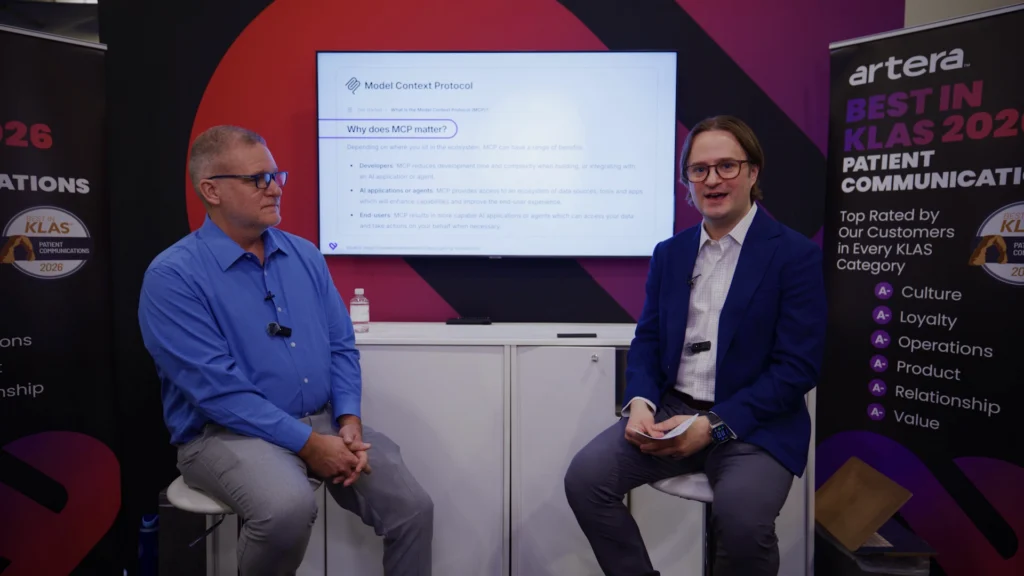
Well, thanks for joining, Josh and I here for, a session on MCP. So model context protocol for the modern health care provider. I’m Zach Wood. I lead product and strategy at Artera.
Josh, would you like to introduce yourself?
Hi. I’m Josh Young. I’m the VP of technology at First Data Bank.
First Data Bank, we’ve around for over four decades, premier provider of drug content and expert knowledge.
And, true partnership here as Artera, we bring AI agents, for the patient and provider, to solve many of, health care’s, toughest problems in that communication.
So let’s start with what is MCP, model context protocol. So I’ll start out and share a little bit on, just background here for all of us.
So MCP, it’s an open source standard. It is with, with these AI agents, a way to connect, standardized protocol to connect with the API’s data tooling that is really important to, make it all come together, to to really perform as, an agentic product. And so MCP AI applications, like Artera’s AI agents, use that to connect with different databases. So in this case, like a medication database to understand all that information in real time to be able to present a great experience for a patient who’s asking questions about their prescription, how they take medications, things like that. So think of MCP as a really standardized way to plug in and access that information in a way that we can set a standard to have great performance in an application like that. Anything you’d add, Josh?
One thing that I like to talk about sometimes that people don’t necessarily get right off the bat with MCP is one of the things that makes it different is it’s the agent really gets to decide when it needs to use the tool. So it’s not a programmer behind the scenes deciding anymore. The agent actually decides when it needs to use it and how to use it. But so in really dynamic use cases, it’s a perfect solution.
Why does it matter?
So depending on who you are, you may have a different answer to this. But if I’m a developer, I wanna be able to access that information, wanna do it efficiently, and it reduces a lot of the complexity for that developer. So we’ve seen that in house with our engineering teams at Artera.
AI applications or agents, they want to be able to get the best information that is accurate and real time to be able to create these experiences, in this case for a patient, to be able to ask questions about their medications. If I’m an end user, I can have more comfort in knowing I’m getting the right answer, not just what an LLM may interpret I want to hear, but actually the correct answer to the questions I have, which in this case could be specifically scary as a patient really wants to understand the type of treatment that they’re receiving.
Anything you’d add there from like the from all these different types of users who are interacting with MCP behind the scenes?
So, I mean, it’s just so important that we get it right. And, yes, the particularly with the with drug content and how fast it’s changing, getting the most up to date information and the accurate information is it’s just paramount.
Like, the foundation models, you can’t build a solid application without it.
As we go through those types of users, if I’m a leader in in any provider organization, I wanna be able to have that trust. You know, I think a lot of these organizations, they have standards that they try to make sure that their vendors use and governance to to make sure that, they have high performing products. And so have you seen that, I guess, from some of the vendors that you’re working with in terms of organizations, like, understanding the value behind using a protocol like this?
Yeah. Absolutely. I mean, it provides the standard interface. It it’s a place for to put in, security.
So it makes sure that it can only access the tools that it should be accessing depending on its use case. So obviously, security is paramount. Observability to see how it’s performing and to know you know, be able to see in real time how it’s doing. So it provides a gateway for those things.
And as opposed to just going out into all the different APIs and having to manage them all individually.
And then there’s always the fear. We’ve seen it with our customers and the conversation with them is hallucinations.
Like, as you’re having some of these complex conversations, being able to trust that you’re pulling from the right data source, that you’re gonna get accurate information, and that an AI agent is not going to have, really go outside of the rails of that.
I think MCP for us has been a true unlock to feel like we have the trust and performance of our agents. But have you seen that in applications that you’ve supported?
Contact is king. I mean and especially now as the frontier models are moving on, they’re really moving on to where we’re just using them to do the reasoning. But the actual data that they’re using, it’s not their training data. It’s the most up to date current data they’re getting through something like MCP.
So MCP, where are we right now in, you know, this this three letter acronym, where we’re going? MCP was, created in, twenty twenty four, from Anthropic, and it’s, it’s built a community. I think that’s important to note. So this has been adopted by organizations, and there’s formal backing now, for organizations across different disciplines like the health care vertical to be able to participate and advance the protocol. But as we’ve both adopted this protocol, where do you see it in the the span of really, adoption, but also just maturity?
The adoption has been amazing, especially in something like health care that traditionally has been kind of slow to adopt new technology. But it’s still, in my opinion, it’s still very early days just because it’s, again, like you said, it’s barely a year old. We talked to some customers like you who are on the cutting edge and using the most up to date tools. But we talked to other customers and they’re still in the early stages of figuring out what this thing is and how to use it.
So definitely still early days with lot of advancements to come. But it’s mature enough right now to be I mean, you can use it. It’s real. It’s a real thing.
You can use it in applications, and in fact, you should be using it in applications.
We found it as a as, like, a best practice standard in in our applications. So current state, okay, it is at a level of maturity that is very useful for AI agents. I’ll tell you at Artera, we have AI agents that when our patients call into a specialty clinic, they’re asking questions whether it be about scheduling, about their appointments, often though about their prescriptions. And so one of the use cases that’s been really important for us is that they can understand if they can get a renewal, how many refills do you have left.
It naturally leads to questions about your prescription, though, that maybe you didn’t have time to talk to a doctor about. How do they have trust then in talking to an agent that they’re gonna get a confident answer? And so I know some of the leaders that in the organizations that we work with, that we’re using an MCP, that protocol, and with vendors that are leaders in the space, like First Data Bank, that’s been very important to them. Have you seen similar types of feedback, I guess, from organizations?
Absolutely. It goes back to the the ability for the agent dynamically. You don’t always know exactly what it’s gonna need, and so some of the use cases that have been emerging are things like yours that weren’t necessarily something we were envisioning. But then when it came up, we were ready or we could adapt very quickly to it.
One of the things we love to address is what are the tips for providers that are wading into the world of agents that are talking either to their patients, to doctors, to pharmacists, and are learning about these products that are really like a new type of experience. Any tips that you’ve given some of these organizations?
Yeah. I think the the biggest one that I give is don’t wait. It’s so easy to integrate with an MCP server, and you don’t need to build some super sophisticated agent before you get to see how it works. Anybody who uses ChatGPT, that’s an agent. That can connect to an MCP server or Claude. So get in and try it and get your hands dirty. And once you start to see how it works and what it can do, it really starts to crystallize how you can use it and use it in your organization.
I think that’s great advice. One of the one of the things that we ask too in getting comfortable with, you this protocol and agents in general too. Ask your vendors.
Are they actually adopting standards? Why should I trust an agent to answer some of these sensitive questions that my patients are asking? And I think those that are building as part of this community, that’s an important factor in your decision at who you work with, who you trust. Okay.
We’ve had a, I think, know, a nice brief discussion here on MCP and technology we’re trying to bring to life for our customers, for our patients, for providers, for pharmacists, for our community.
As we’re looking forward to close this out, what do you think the next three to six months look like, Josh, as as we’re, you know, continuing to evolve and using the standard?
More use cases as people get more comfortable and and move into this more and more, we’re gonna see more use cases arise on our side. It’s just gonna be increased content. And, you know, MCP can go in front of data. It can go in front of applications. And so there’s all kinds of things that it unlocks as a technology that we’re just scratching the surface on. So but at the pace that you can evolve these things now, I think we’re gonna see even radical change in the next six months with it. So nothing but adoption, man.
We’re excited too about adoption. Adoption.
And I think for Artera, as we’re looking at the next three to six months, we’re committed to being part of this community, driving standards, and that needs to create high levels of performance for these agents so that patients and providers can trust the answers they’re getting.
And so we love the partnership we have here and the ability to, you know, continue to evolve this as we’re solving problems for patients and providers. That’d be great, Matt. So I’d like to thank you for having this conversation with me. And this group, we’d love to continue the conversation, answer any questions, and feel free to reach out to us or the team. So thank you all. Thanks, Zach.