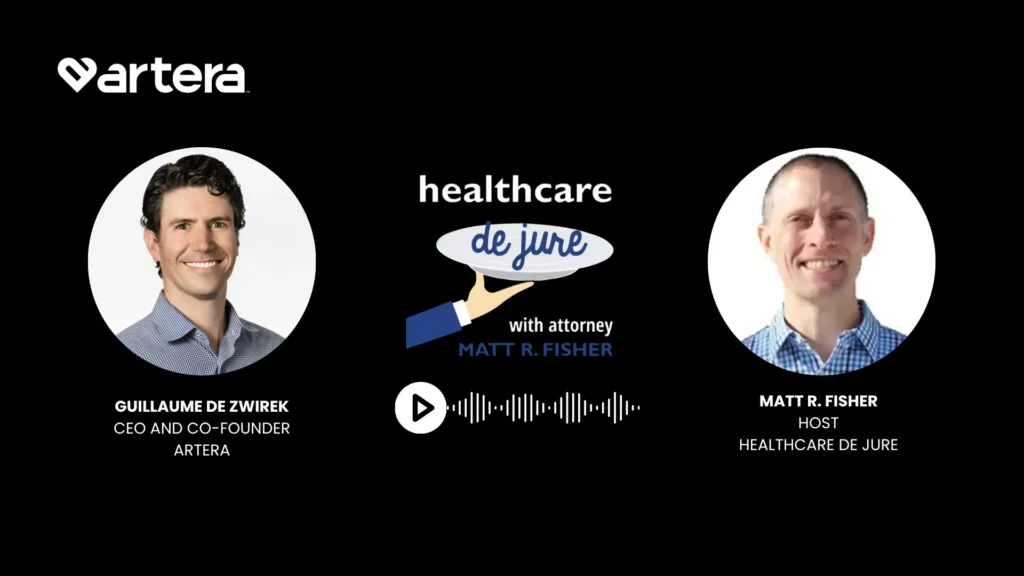
Artera co-founder and CEO Guillaume de Zwirek recently joined Matt Fischer on the Healthcare De Jure podcast for a conversation about how patient communication has evolved over the past decade, from activating text messaging in healthcare to deterministic automation to today’s agentic era. Gui makes the case that agentic AI in healthcare isn’t one revolution but three distinct shifts in a single year, and that the organizations getting the most value are the ones willing to forget how they used to work and let the technology do the job.
The conversation covers:
- The three shifts inside the AI revolution — generative, reasoning, and agency — and why most people are still thinking about AI the way they did three years ago
- Why “less is more” in healthcare AI: how limiting the information an agent can access is exactly what makes it safe
- Why agentic scheduling works best when you hand the agent your goal instead of your rulebook
- Gui’s advice for healthcare leaders who want to get smarter about AI: stop scripting the “how,” and start using it every single day
You can listen to the full episode on Healthcare De Jure, on YouTube, Apple Podcasts or SoundCloud. A transcript of the conversation follows.
[QUESTION, MATT FISCHER]: Welcome back, and thank you for joining us as we dive into the hottest topics in healthcare. On the menu today is Gui de Zwirek, CEO and co-founder of Artera. Gui, welcome to the show. What I always like to do at the beginning of every show is give my guests a chance to introduce themselves — who they are and what they do. So, Gui, the floor is yours.
[ANSWER, GUILLAUME DE ZWIREK]: I’m an entrepreneur. I co-founded this company about 10 years ago. I’ve got an interesting background — I’ve been described as a renaissance man before. My first career was as a classical musician, then I tried to become a professional athlete, then I worked in tech, and then I decided to found a healthcare company. So this was my first time in healthcare and my first time founding a business. A decade in now, this has been the most enduring period of my life.
Healthcare is a fascinating industry with lots of unique challenges, but a real feel-good component to it. I got into this business because, in my quest to become a professional athlete, I started having personal healthcare issues, and I became really frustrated with the state of coordinating my care. It seemed really obvious that technology could fix this problem. I’d spent the previous few years at Google and was naive enough to start a company to apply tech to the challenges I’d had — the end-to-end patient experience. It was frustrating, it was analog, it was on the phone, there were a lot of manual handoffs. And it was a very solvable problem. So here we are 10 years later, still solving it — but going through a complete paradigm shift in the way problems are solved. I’d argue I’m having more fun than I’ve had in 10 years, because we’re going through a massive revolution right now in how things are made.
[QUESTION, MATT FISCHER]: You mentioned that since you got into healthcare about 10 years ago, there’s been a massive paradigm shift. What was your first idea when you got into healthcare, and how has that evolved to where it is now?
[ANSWER, GUILLAUME DE ZWIREK]: The experience back then — and candidly, to this day — is a lot of phone calls during business hours. You hit an operator who transfers you to the right department, and a lot of the time the person who answers can’t actually help you in that moment. Maybe you need to speak to a clinician, so somebody takes a message, and then you’re playing phone tag. That’s true for clinical questions, scheduling, prescription refills, referrals — go down the list of needs across a care journey. Healthcare largely still operates that way.
Ten years ago there was a different technological wave: mobile. Everything was moving from web to mobile, and at Google we saw rapid adoption of messaging. But SMS really didn’t exist in healthcare outside of the annoying, spammy texts asking you to press one to confirm or two to cancel. And most of that was done over interactive voice response — a robot calling your landline at 6:30 p.m. while you’re sitting down to dinner. The thesis was: my experience would be so much better if we could just make this asynchronous. Let’s activate texting in healthcare, and let’s make it human — so the amazing staff at hospitals can actually respond to your questions. “Hey Matt, are you coming to your appointment?” “Actually, no, I’m unexpectedly out of the country. Can we reschedule?” That gets reassigned to a staff member and solved asynchronously. You never pick up the phone. That’s what we introduced 10 years ago, and it went really well. There was a massive appetite for more convenient access — for patients, and for the staff managing all those tasks.
The next paradigm was automation — and I don’t mean today’s AI. I mean deterministic automation. If this happens in the database, then do this thing. Triggers became multi-step — think decision trees. Companies like Zapier built their names on these WYSIWYG deterministic workflows. We built our own version, and it automated a lot of the job.
The current phase is agentic. But it’s a disservice to just say “we’re in the agentic revolution,” because we’ve actually gone through three different revolutions in the last year. The first was generative AI: ask a question, get an answer. Cute. The second was reasoning: get something to do research for you. Useful. The third wave is agency: actually getting work done. You tell a machine to complete a task, and it does it. That’s completely changing how work gets done — internally for people like you and me, and externally through the agents we sell to healthcare.
[QUESTION, MATT FISCHER]: With that agency stage, how do you know it’s accurate and doing what it should? I imagine that’s a question you get a lot — people see a headline and think they understand agentic AI, but they’re missing the nuance.
[ANSWER, GUILLAUME DE ZWIREK]: Most people don’t understand those three shifts. Folks who aren’t deep in agentic AI still operate like ChatGPT did back in 2023 — a glorified chatbot. It was amazing, you could talk to it, but it wasn’t doing deep research and it wasn’t completing tasks. There have been fundamental shifts in the technology since then, and in healthcare we’re highly regulated — we can’t mess around with PHI and PII, and we can’t mess around with clinical guidance. If you’re still in the ChatGPT-three-years-ago mindset, you’re thinking about it all wrong.
There are a couple of standards right now. One is Model Context Protocol — MCP — an open-source framework Anthropic pioneered and donated to the Linux Foundation. The other is A2A, championed by Google. What those protocols do is let you plug into external systems like the EHR and retrieve information safely. Say you’re on the phone with an AI agent and you say, “I’m about to run out of my Lipitor and I’m traveling — can you mail-order it?” The agent queries the server: “Show me Matt’s active prescriptions.” It returns the exact set. It’s not going to make it up.
We actually wrote a blog post about this recently, because to make the guardrails work, you want to limit the information you give the AI. If I only return that Matt has Lipitor, the agent can’t make up that you’re taking something else — you gave it one thing, and it gives that back. You’re controlling the inflow and outflow of information. That’s changed the game, and frankly made these systems very, very safe. We haven’t started with clinical use cases — we started with lower-risk administrative ones that eliminate rote manual work.
Listen in as de Zwirek explains why, in healthcare AI, less is more.
[QUESTION, MATT FISCHER]: You made what almost sounded like a throwaway point — that limiting the information it can access helps the guardrails work better. That seems counterintuitive, because some of the fear is that you’re throwing open the floodgates and expecting the tool to make sense of it. It sounds like narrowing it down actually helps.
[ANSWER, GUILLAUME DE ZWIREK]: The way LLMs work, there’s a context window — some new models can hold a million values — and the model churns through all of it. The more information you give something, the more it can make up. So when you’re solving a specific workflow problem, you actually want to limit the scope to only the information that matters.
We see it as a common mistake that new entrants — AI tourists — make. A company hears about MCP, launches an MCP server, and when we test it we’re asking, “Why are you returning 5,000 strings of JSON when I asked one specific question that’s properly stored in your database?” You want to limit the aperture to just what the AI is asking for, and take away its liberty to make up an answer. Now, if you’re trying to figure out a patient’s cancer risk, that aperture might be broader — but don’t give it access to every database table. Don’t fill the context window. Only give it what’s pertinent and relevant.
[QUESTION, MATT FISCHER]: Do you have frameworks or suggestions you work through with customers to guide them away from wanting to just dump information on you — to help them see the value of limiting that aperture?
[ANSWER, GUILLAUME DE ZWIREK]: It depends what the customer wants, and there’s going to be an adoption curve for agentic solutions in healthcare. If you want a glorified chatbot, you upload some knowledge bases and it’s a slightly better experience. Candidly, I don’t find that very valuable. The real value is when you can actually get something to do the work for you.
When we set up these agents, there’s an LLM underpinning everything, and you can choose your platform. There are different considerations — an organization might be a Microsoft shop, or you might be deploying to the government, where today there are considerations around not using certain providers. So we built the platform to be LLM-agnostic. Then we guide customers to upload the appropriate knowledge bases so we can retrieve the right one for the patient’s question. Maybe you’re prepping for a colonoscopy and have a question about the orange jug versus the blue jug — it retrieves the right knowledge-base article, so the agent is fine-tuned and not referencing the entire corpus of the internet. You have to be really careful about unleashing that on a specific patient question.
Then we set up servers based on the tasks at hand. Surprisingly, one of the top use cases is patients asking, “When’s my appointment?” You’d be shocked how many people call a practice just to confirm — it’s upwards of 15%. That requires a couple of skills: authenticate Matt, and look up the upcoming appointments and read them back. Those are two very specific skills we can guarantee almost 100% of the time. When it’s not successful, it’s usually because extra guardrails created friction. For example, if a customer says, “Don’t tell patients about appointments in the past,” and I call asking about an appointment that was five minutes ago, the agent can’t respond — so we hand off to a human.
The next phase beyond verifying appointments is scheduling — “I can’t make it, can I reschedule?” Then medication management, billing inquiries, referral status. Those five things capture about 70% of human needs, and an agent can do it more reliably and quicker than a human. It works 24/7 and can handle hundreds of thousands of simultaneous sessions. When I think about my mission, it’s a game changer for the patient experience. Matt, if you’re the one patient having an acute issue who needs a human, and I can get rid of 80% of calls and make sure somebody answers on the first ring and gives you compassionate care — we’ve just made healthcare better for everybody.
[QUESTION, MATT FISCHER]: It makes intuitive sense — those five or six interactions you named are exactly the ones people complain about most. Most people aren’t complaining once they’re in front of their clinician; it’s getting to that point. Reducing that friction makes a big impact on satisfaction.
[ANSWER, GUILLAUME DE ZWIREK]: Here’s something else that’s counterintuitive. When we deploy agentic scheduling, the first thing we hear is, “Here are all the rules. Dr. Matt only sees patients Tuesdays and Thursdays between 10 and 2. He’ll see one hip, not two. If they’ve been seen by another doctor, send them to a PA first.” There’s a long list of requirements, and what ends up happening is it doesn’t feel like an agentic solution anymore, because the agent is forced down a script even when it already has the answers.
So what we’ve started doing is telling customers: we know you don’t fully trust agentic solutions yet. But your goal is probably to fill your slots with as many appropriate patients as possible. You’re better served giving that goal to the agent and letting it determine which questions to ask, when, and when not to — based on what it already knows about that patient. That delivers a much more efficient experience. Instead of a six-minute call answering 12 annoying questions, you get a two-minute call with the same right outcome and the right patients booked.
It’s a mindset shift we need to keep developing with the provider community. The more you limit the AI’s ability, the worse the experience and the worse your schedule will be. You’re talking about an agent that has the world’s information at hand, understands your scheduling patterns, has access to the EHR, and knows what’s worked and what hasn’t. I guarantee it’s better at optimizing your schedule than you are — but until you see it in practice, that’s hard to believe. So when people ask how to get smarter at this, my answer is: play. Install Claude Code on your personal machine. Don’t send an email anymore — talk to AI and have it send the email. Hook it up to your calendar, your side business. My gut reaction now whenever I have a task is to ask my AI to help. The output is 10 times better and I do it 10 times faster. I feel like I have a dozen of the highest-skilled recent grads at my disposal, and my job becomes a manager’s job: applying critical thinking to question and inspect what I’m told.
[QUESTION, MATT FISCHER]: A lot of it sounds like unlearning behavior you had to develop because there was so much friction before — building all those rules because the people doing these tasks couldn’t intuitively track all that information, whereas that’s one of the built-in purposes of the tool.
[ANSWER, GUILLAUME DE ZWIREK]: Exactly — you had turnover, you had to train new staff, you built a binder. It’s the classic sunk-cost fallacy in this age. You need to forget how you used to work. Forget the “how.” All that matters is: what am I trying to accomplish? Then let AI figure out the how — and iterate with it. Don’t just send AI off on a task. I put my AI in plan mode and say, “I have this problem, chat me through some possible solutions.” I have probably 15 terminal windows open right now, 15 different agents working for me. My biggest problem now is the limit on how much I can multitask and context-switch. Sometimes it makes something up and I say, “Are you sure? That doesn’t compute with what I know,” and it says, “You’re right.” We iterate to a solution together, and then I tell it to go build it and check back with me. Forget how we did things before, go back to the objective, and you’ll find there’s a new way of working, a new way of buying technology — a new way of everything.
[QUESTION, MATT FISCHER]: It frees you up to go straight to the critical-thinking part of a problem. Gui, believe it or not, we’re almost out of time. I’ll close with one final question: agentic AI has gone through three shifts in the past year. Where it is now, what do you think is the next stage we’ll see?
[ANSWER, GUILLAUME DE ZWIREK]: Such a good question. To fully take advantage of this agentic period, we need a lot more compute, and different types of chips — inference chips, different from what’s been popularized by Nvidia. And we need infinitely more access points into the ecosystem of healthcare solutions so an agent can complete more and more tasks. So we’re in a very important phase right now, which I’d call the interoperability phase. We need to do it safely, enforce the right guardrails — less is more — and inspire every healthcare IT vendor under the sun to adopt these standards. I’m a free-and-open-market person. I want to see a rich ecosystem of MCP and A2A servers developed. I want people to test them, and for all of us to grow by sharing what works and what doesn’t.
We’ll be in this phase for a while. There’s a compute problem being worked on, our need for inference is going to go up exponentially, and the thing driving all that demand is more access points into the healthcare tools we use. If you wear an Oura ring, if you have a CPAP machine — those are all access points that let healthcare deliver better, cheaper, more responsive care to every human on the planet. That’s what excites me. I guess you could call it interoperability, but it’s really the current challenge ahead.
[FINAL THOUGHTS, MATT FISCHER]: It’s a big challenge, but an important one — certainly something to keep an eye on. Gui, thank you for a great conversation today. And thank you to everyone listening. Keep the dialogue going and connect with me at #hcde. I’m Matt Fischer. Until next time.