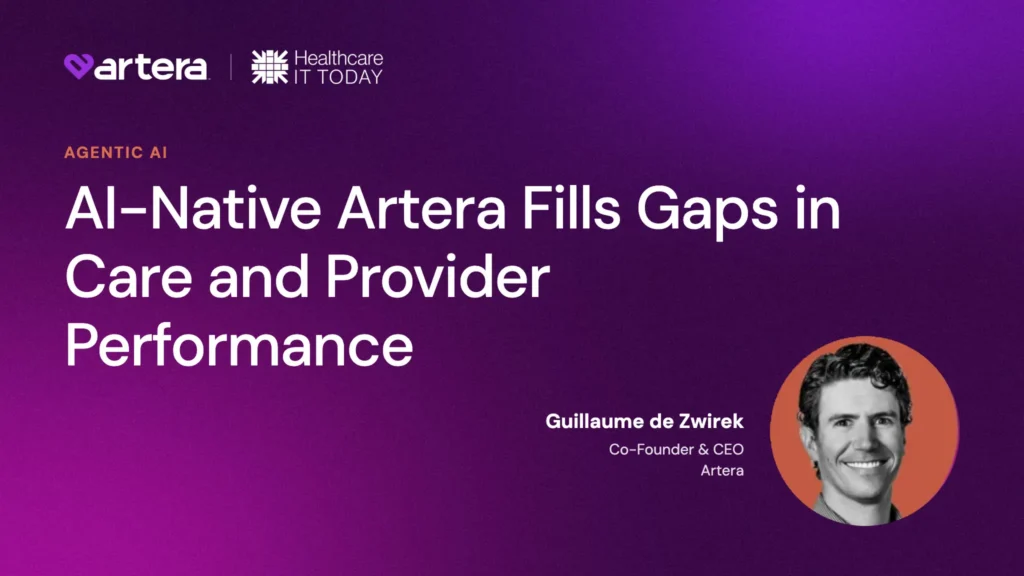
On the latest episode of the Healthcare IT Today podcast, host John Lynn, Founder and Chief Editor at Healthcare IT Today, sat down with Guillaume de Zwirek, CEO and Co-Founder of Artera, to talk about what’s changed in patient access over the past decade — and why Artera no longer runs like a traditional software company at all. De Zwirek walked through Artera’s evolution from a HIPAA-compliant texting tool into what he calls an “AI-native” company, using a simple test: if you removed the LLM, would the company still function? A year ago, it would have. Today, it wouldn’t.
A few of the specific talking points from their conversation:
- Why Artera applies that AI-native test to itself, and what it means that employees are now roughly 40% more productive than they were a year ago
- How Artera’s agents close care gaps during routine scheduling calls instead of relying on outbound campaigns patients often don’t answer
- Why de Zwirek insists on self-hosting proprietary models rather than buying inference directly from foundation model labs
- How AI service squads replaced the traditional chain of client exec, implementer, and product lead with just two points of contact per customer
You can watch the full interview on YouTube or read more from Healthcare IT Today here. A transcript of their conversation follows below.
[QUESTION, JOHN LYNN]: Welcome. For those who maybe aren’t familiar with you and don’t know how to pronounce Guillaume, tell us a little bit about yourself and Artera.
[ANSWER, GUILLAUME DE ZWIREK]: I founded the company just over a decade ago. My background is in product and big tech. Our mission is to make health care the best industry when it comes to customer service. The company came out of personal pain — health care is complicated, but it shouldn’t be. It’s laden with phone calls and wait times and confusing bills that don’t, and through a lot of innovators working on these problems over the last ten years, shouldn’t have to be problems any longer. We can really deliver on that promise of effortless, seamless, concierge-type care for every single person on the planet.
[QUESTION, JOHN LYNN]: I love that vision. Health care is complicated, so it’s great that you’re helping to improve the experience for patients. I think it’s interesting that Artera has been in health care for over a decade. How has the company evolved into what I’ve seen you phrase as an “agentic health care company”?
[ANSWER, GUILLAUME DE ZWIREK]: Agentic AI has been the buzzword for a few years now, and we’re staring at a couple of massive IPOs with Anthropic and OpenAI right after. But it’s not just a buzzword — agentic is these systems actually being able to complete end-to-end processes better and more efficiently on the terms of the patient than ever before. Let’s take a step back. The core of everything in health care is the relationship. Without the relationship, what do you have? A widget is a widget. But without strong relationships and the belief that the person on the other end is going to do what they say, when they say, everything falls apart.
When we started this company, it was all about investing in that relationship — creating a more convenient way for patients and medical staff to talk to each other. Gen 1 had no automation, no AI. It was truly enabling modern communication channels — in our case, HIPAA-compliant text messaging — so clinic staff could talk to patients the way they’d talk to any other contact in their address book. As we gained more customers and learned more about their needs, we noticed a lot of their communications are rote and expected — your lab results are ready, appointment reminders, overdue bills, open care gaps. The next step was automation: deep integration into source systems — EHRs, RCMs, PMS — building domain expertise across all the major EHRs.
Then came multi-threaded, deterministic multi-step workflows — the health care equivalent of what IFTTT or Zapier did for other industries. “Hey John, you had an open care gap, can I help you schedule that?” Natural language understanding, but still deterministic. Then agentic AI showed up, which lets you customize the experience to the infinite permutations of a patient interaction. Health care shouldn’t be complicated for the patient — all that complication should be below the waterline, handled by people and technology. AI can learn a patient’s needs on a call, check source systems in real time, spot an open care gap, book a specialist and the care-gap visit back-to-back, and pre-fill forms from the natural conversation — all without ever handing over a form.
[QUESTION, JOHN LYNN]: Going back to the relationship point — doctors and nurses are the most trusted professionals out there, which creates a bigger burden for you to maintain that trust with agentic AI tools. Ironically, people trusted doctors even through long waits and repetitive forms. How do you approach maintaining — or even enhancing — trust while making the process more efficient?
[ANSWER, GUILLAUME DE ZWIREK]: There isn’t a high degree of trust in AI generally right now — look at AI lab CEOs saying “slow down” on foundation model development. So building confidence with clinic staff who’ve perfected workflows over a decade means reimagining what “showing trust” looks like. Historically, software companies built trust through analytics dashboards — X axis, Y axis, here’s what we did. That doesn’t work for agentic AI, because every conversation is different. So when a physician asks why a patient was scheduled with them, or why their Tuesday morning was suddenly open, we need to prove with 100% certainty why that decision was made.
We’ve reimagined reporting — AI writes deep narrative explanations on the spot for every physician, tied to specific policies: why patients are falling out of the funnel, say because the clinic doesn’t accept a certain insurer and the patient was rerouted to a neighboring doctor, surfacing PHI-redacted threads that show the agent’s logic. But the actual patient conversation won’t feel like a rigid decision tree — it’ll feel natural, with the agent constantly figuring out the next best thing to ask and how to take administrative burden off staff. The goal: you walk in, skip the waiting room, go straight to the doctor, and the doctor has five extra minutes to ask about your kids. That’s relationship-building, and that’s what creates great experiences.
[QUESTION, JOHN LYNN]: You mentioned Gen AI is hot, but maybe even hotter in health care is voice AI. Why is voice AI generating so much excitement, and what should providers understand about what it actually takes to solve patient access challenges?
[ANSWER, GUILLAUME DE ZWIREK]: Call centers are cost centers, and tens of millions of patients call a clinic or hospital every day. If you look at the staff needed to maintain those relationships and the turnover of that staff, AI has the opportunity to create equilibrium in the patient experience: eliminate phone wait times, provide direct access to care, free up staff, and manage volume spikes, like the post-New Year’s rush.
The prior solution, interactive voice response, was very limited — a pre-programmed tree. But every health care journey is different. I was working with a customer last week that has 21,000 payers. A deterministic IVR tree can’t handle 21,000 payers and their constantly changing reimbursement policies, but an AI agent can.
Two big considerations when launching this technology: first, the experience has to be as good as a human’s. Second, and perhaps most important, is security. There’s a “Wild West” element to the current influx of solution providers. A practical example: zero data retention. You don’t want PHI, or even anonymized PHI, going to foundation model labs — that’s your IP. Most companies buy inference directly from foundation model providers like Anthropic, OpenAI, and Google, and while those providers will sign zero-data-retention agreements, they can’t actually guarantee no memory leakage. I heard a podcast last week that demonstrated IP leakage to other companies. Doing it right means self-hosting your own models in dedicated clusters — more expensive, more engineering work, but the right long-term approach, even if a cheaper approach would pass a security audit today.
[QUESTION, JOHN LYNN]: You started pre-AI, with modern communication techniques health care hadn’t adopted yet. Now you describe Artera as an AI-native company. What does that mean, especially since you’re self-hosting your own LLMs?
[ANSWER, GUILLAUME DE ZWIREK]: There’s a simple test for whether any company is AI-native: if you removed the LLM, would the company still function? A year ago, ours would have. Today, there’s no way we’d survive. Every employee is about 40% more productive than a year ago, and that’s only possible with a foundation model. We maintain redundancy across several self-hosted foundation models in our Bedrock environment. When Anthropic had a major outage earlier this year, we were unaffected because we also run a self-hosted model on leased Amazon servers.
In practice: every customer conversation is recorded, with permission, so work doesn’t get lost in a game of telephone across decision-makers. We’ve eliminated the traditional layers between customers and engineers — PM, implementer, client success exec, integration engineer, product lead are gone. Our “builders,” what used to be called software engineers, talk directly to customers and can run six concurrent AI sessions solving customer problems. None of that is possible without recorded conversations and a foundation model doing the heavy lifting.
[QUESTION, JOHN LYNN]: It’s fascinating. The old advice was “if you want to know what customers are saying, ask the call center people.” You’re doing that, but at scale, with recorded, AI-summarized conversations instead of relying on individual staff.
[ANSWER, GUILLAUME DE ZWIREK]: The most exciting asset we have is the live conversations themselves. When our agent completes a long-horizon task autonomously, like scheduling an appointment while also handling five other things in that same engagement — open care gaps, expired medications, open balances — that’s something most humans could never juggle manually. You’d need a perfectly configured CRM and trust that every rep checked all twenty fields.
What’s most interesting is when things go wrong, when a patient asks for a human, or policy requires escalation. We look at what happened, how the human navigated it, and where there’s an automation opportunity. One example: a national GI provider was nervous about letting AI handle colonoscopy scheduling. Once we reviewed PHI-redacted transcripts of how humans handled those calls, we found nothing the humans did was beyond the agent’s reach, and we eventually took on that workflow and improved on it. Phone trees shouldn’t exist. Every clinic call should start with an AI that says, “This is an AI for [Clinic]. How can I help?” I have a story about calling in a panic about my daughter’s first-birthday fall, and even just saving that one minute of disclaimers before getting to a nurse makes a real difference.
[QUESTION, JOHN LYNN]: I’ve heard you talk about an “AI service squads” model. How does that work, and why did Artera go this route?
[ANSWER, GUILLAUME DE ZWIREK]: The traditional org chart for a software or services company has a client executive who routes requests to implementation, which routes customizations to product, which prioritizes and specs them for engineers, who build it, and it flows back through implementation to the customer. A lot of layers. We’re not really a software company anymore in that sense: our customers have just two points of contact — their “builder,” who solves problems directly, and their client experience manager, who helps coordinate access to the data the builder needs. We removed six layers between the customer’s problem and the people solving it, at scale, across a company that’s been around a decade with a couple hundred employees.
[QUESTION, JOHN LYNN]: Walk us through some of the bespoke solutions your squads have built.
[ANSWER, GUILLAUME DE ZWIREK]: One example: a large federally qualified health center, a market I care about personally since my mother worked as a provider, had outsourced a 200-person call center overseas that couldn’t keep up with volume. FQHCs are under heavy funding pressure and have real access problems. We deployed AI to handle the bulk of their scheduling calls by ingesting their existing documentation and letting the AI navigate the nuances.
Then their COO raised a bigger challenge: they had a large list of care gaps they needed to close, good for patients and necessary for proper reimbursement, and their old process was to export the list weekly and call patients who often didn’t answer. Since hundreds of thousands of patients were already calling the AI every month anyway, we reconciled every active caller against the care-gap list and closed gaps on the spot, eliminating the need to call patients separately, and solving other things in the same engagement — family members needing care, dental coverage questions, eligibility changes for undocumented individuals, and more.
Another example: intake forms. Instead of a vendor link or an annoying in-clinic tablet, tapping through a hundred conditions instead of one line like it used to be on paper, the AI can just ask a few quick questions over the phone right after scheduling and do a full registration conversationally. Health care should “zero-base” the question: if you had the most capable human at the front desk, checking referrals, authorizations, and payments in the background and never forgetting anything about you, what would the ideal experience look like?
[QUESTION, JOHN LYNN]: Unfortunately at many organizations, the experience is still “here’s a clipboard,” or AI adoption is really just a glorified IVR to check a box for the board.
[ANSWER, GUILLAUME DE ZWIREK]: The bar should be the humans. After security, the next question should always be: will this improve the patient experience, free up time for staff to give real care, and let us escalate faster? There are so many sad workflows today, like writing a “telephone encounter” into the EHR for someone to follow up on later. We should eliminate that and connect people right away.
[QUESTION, JOHN LYNN]: As you look ahead, what should providers look for when evaluating AI partners, and where is this market headed?
[ANSWER, GUILLAUME DE ZWIREK]: Treat it like hiring an employee with a high bar. Ask the agentic AI system about its “prior experience” — has it worked in a similar EHR, in a specific specialty clinic, handled a hard patient situation? Ask about capacity, quality, and how it proves what it’s doing: reporting, auditing. Ask how it’s handled private information and whether there’s ever been a leak. Ask how it handles surge capacity. It’s basically a full job interview: do you trust the system, has it been trained well, and do you trust the people controlling it?
Then, post-hire, assess performance over 30, 60, and 90 days just like an employee: how many patients did it schedule, were they satisfied, what else can it take on, like med refills and renewals? That frees up humans to do the job they actually wanted to do. Most people came into health care, whether sweeping floors, answering phones, or wearing scrubs, because something personal made them want to fix how things run. Burying them in administrative busywork is what makes people want to quit. Our job is to take on that work so doctors can be doctors, front-desk staff can build relationships, and everyone can see the difference they’re making.
[QUESTION, JOHN LYNN]: It’s interesting — we don’t ask human hires “are you going to be perfect?” but we do ask that of AI.
[ANSWER, GUILLAUME DE ZWIREK]: Right, there’s a lesson there. We should compare AI against the realistic alternative, not against perfection. Another key value is honesty. There’s a lot of FUD in this industry, and a common but disingenuous question is “how much can you do for me?” because you can inflate that number by changing the denominator, like only counting calls where a human picked up and all the stars aligned. The honest way to answer is to compare the agent’s success rate against what a human’s success rate would be on the exact same calls, and be upfront about what you’re not yet allowed to do. Just like an employee who starts in one role, proves themselves, and earns more responsibility over time, we should think of agents the same way, and companies owe it to customers to be honest about success rates, security policies, and how past issues were handled.
[FINAL THOUGHTS, JOHN LYNN]: Every organization is grappling with how, not whether, AI will be an enabler in health care. Thanks so much to Guillaume for sharing these insights, and thanks to everyone for watching. If you want more content like this, check out healthcareittoday.com or search “Healthcare IT Today” on your favorite podcast app.