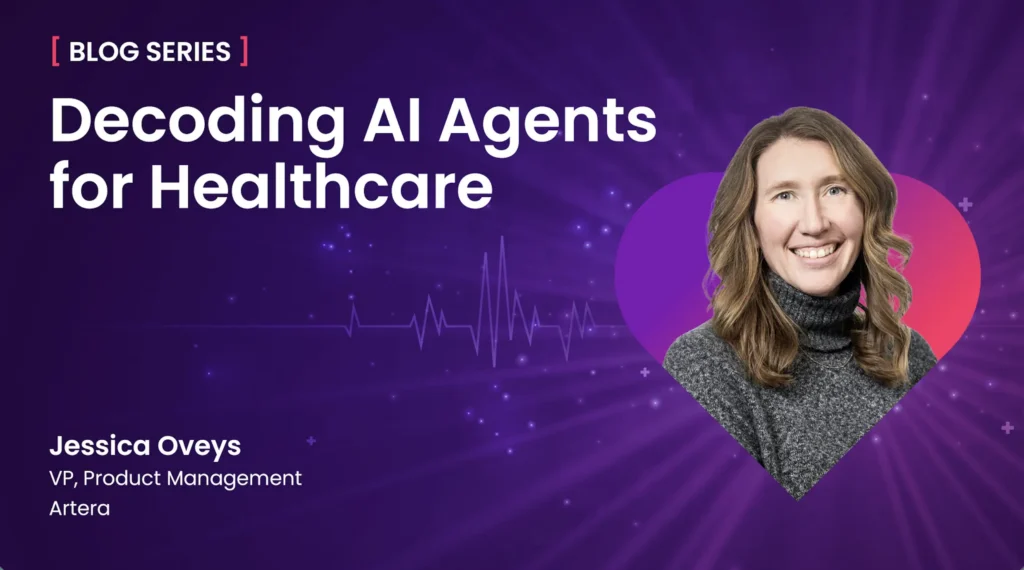
By Jessica Oveys, VP of Product Management, Artera
The healthcare industry has operated under one non-negotiable principle for decades: it has to be perfect. Lives are on the line. Regulations are strict. Mistakes aren’t just costly – they can be catastrophic.
But something is shifting. AI agents for healthcare are making the industry faster – not just at answering patient calls or scheduling appointments, but at identifying problems, testing solutions, and releasing improvements. The failure-to-fix cycle that once took months now takes days, sometimes hours. That changes everything.
For providers considering patient-facing AI voice agents: don’t be afraid. You don’t need perfection on day one. You need a problem, a small team, a willingness to iterate – and a partner who sees around corners with you.
Start Here: Trade Traditional SaaS for a Dynamic AI Services Model
The biggest shift in your operations isn’t technical – it’s letting go of the rigid healthcare IT implementation mindset. Historically, deploying new technology meant a grueling sprint toward a single “Day One” launch, with absolute perfection expected upfront, because changing a workflow later meant waiting until an annual software enhancement cycle, complex updates to printed guides and extended user trainings.
AI agents break that paradigm. To move with real agility, healthcare organizations have to adapt past hands-off SaaS contracts and toward vendors that offer an AI Services Model, like Artera.
Instead of looking for a single solution to a single problem, organizations have to start focusing on finding a holistic AI partner: human builders with combined healthcare and AI expertise who work directly with your organization to solve its unique challenges – at the speed of software, with custom solutions.
That partnership is the engine that lets you trade “upfront perfection” for continuous, rapid progress. Rather than delaying a launch for six months to anticipate every patient scenario, you deploy a secure, compliant baseline workflow. From there, your AI services partner monitors live patient interactions, sees what’s actually happening, and iterates on the fly. Optimization work that used to dictate a 12-month roadmap gets executed in days or weeks, not quarters.
This is how you leverage AI in this new agentic world. Everything below is the foundation that makes it work.
Foundation 1: Identify the Operational Problems Worth Solving
Before diving into complex workflows and documentation, ask two foundational questions:
- What’s the biggest challenge our patients face when engaging with us?
- What am I spending my time doing that’s beneath my skill set?
These often lead to the same place: better patient engagement and freeing providers from low-value administrative tasks. Patients want to connect with their provider, not a burnt-out provider who spent the night documenting referrals.
Once you’ve identified a focus area, map the pain points. Where are patients getting stuck? Where are staff hitting bottlenecks? Would a healthcare AI call center absorb the volume that keeps them stuck? Is poor outbound communication creating new inbound problems?
Peer-reviewed work on workflow automation points the same direction: the strongest early candidates are high-frequency, well-documented administrative processes rather than edge cases. Source: PubMed Central, ‘Identifying Opportunities for Workflow Automation in Health Care,’ 2021).
If you aren’t sure where to look first, revisit your digital transformation roadmap from the last 2–3 years. Did you hit those goals? If not, start there. Those unmet objectives are often ideal entry points for AI – core patient needs like scheduling, paying, and accessing care haven’t changed; they’ve just gotten more complicated.
A new Signify Research report about specialty voice AI uncovered that specialty practices carry some of the highest call volumes and most complex scheduling workflows in patient access, which makes them a natural early proving ground.
But here’s what I want you to hold in the back of your mind as you do this exercise: the problems you can name today are just the beginning. The most valuable problems AI will solve in your organization are ones you haven’t identified yet – because you’ve never had a system capable of seeing them (more on that in a follow-up piece).
Foundation 2: Determine What’s Prime for Agents
Not every organization is ready to dive 100% into AI Agents, so not every workflow is a good fit for AI agents – right away. Here’s the quick litmus test for finding what is “agent-ready” for your org:
- Repeatable: The process happens frequently across the organization.
- High touch: Multiple people perform it regularly.
- Low clinical risk: Minimal chance of adverse patient outcomes.
If you’re new to AI voice agents in healthcare, start with workflows that check all three boxes. As you build confidence and your AI voice agent capabilities mature, you can tackle more complex, higher-stakes use cases, especially with a partner who can evolve with you.
The ceiling for self-service is higher than most teams expect. In one healthcare organization’s weekly AI voice agent report, 38% of all inbound calls (2,469 of 6,564 in a single week) were handled fully by the agent with zero staff involvement, up one point from the week before. The classic front-desk workload fits this profile exactly: an AI medical receptionist booking, rescheduling, and verifying appointments is repeatable, high touch, and low clinical risk, which is why AI patient call automation is usually the first box checked.
Today, you no longer need a roadmap with multiple use cases mapped out for the next 3 years. You start with a core problem and let the agents bring you the unforeseen problems you don’t know about. Your “roadmap” builds over time programmatically, quickly, and continuously.
Foundation 3: Assemble a Small, Thoughtful Team
This is the hardest habit to break. Large, cross-functional teams that meet weekly slow you down. Deploying AI agents calls for a small, agile group that deeply understands the business need and can communicate updates to the rest of the organization.
Don’t exclude the skeptics. Include the doctor who doesn’t love AI and the front-office staffer who swears they’ll never use it. Their hesitation is valuable; you don’t have to act on every concern, but those concerns reveal blind spots you’d otherwise miss.
Keep one perspective front and center: patient engagement voice AI for healthcare is very different from clinical decision-making AI. Today’s patients interact with AI daily, from booking travel to managing finances. They can handle occasional friction, and they don’t expect absolute perfection, so your team shouldn’t let the fear of it paralyze progress.
Foundation 4: Build and Continuously Refine Your Operational Documentation
Deploying an AI agent starts with a foundation of truth. AI agents don’t guess your clinic’s rules or protocols from the open internet. To stay safe and compliant, you train the agent on your internal documentation: operational guidelines, prep instructions, and standard operating procedures. Think of it as a secure, closed knowledge base – every answer the AI gives a patient is pulled directly from this internal playbook, which keeps it from hallucinating.
Start with your most experienced people: the ones who’ve been there 10, 15 years. Interview them. Shadow them. Capture what they do that they never wrote down: the personal touches, the reminders they give patients, the shortcuts they’ve developed.
But this isn’t a one-time exercise. Staff will deviate from the original process and make adjustments, and you’ll want the AI to know about them. That means committing to continuously refining your documentation.
That refinement shows up in the weekly numbers. At one multi-site healthcare organization, application errors fell 7.9% after a single root-cause fix, and mid-call hang-ups dropped 6.4% the same week. Iteration here is measured in days, not quarters.
Final Thoughts
If you take one thing from this: you don’t have to be 100% ready – you just have to start.
Find the right partner, and the right AI agent platform to iterate alongside you. Start with patient pain points and administrative burdens, pick repeatable, high-touch, low-risk workflows, build a small team, and commit to maintaining your knowledge base. In the world of AI, the goal was never perfection before launch: it’s progress.
But deploying well is just the beginning. The organizations that pull ahead aren’t only the ones that launch AI agents successfully – they’re the ones that understand what those agents are about to reveal, and stay ready to act on it. That’s where this is really going, and it’s the subject of Part 2: The Frontier.
AI agents for healthcare: questions to ask before you start
How much operational documentation do we need before a first agent takes live calls?
Enough to cover your top call reasons end to end: scheduling rules, prep instructions, and the standard operating procedures your most tenured staff carry in their heads. The agent answers only from this closed knowledge base, so gaps surface fast in the first weeks of live calls. Plan for a standing refresh cadence rather than a one-time handoff.
Which workflow should a multi-site group automate first: inbound scheduling or outbound recalls?
Run both through the litmus test above. Inbound rescheduling, cancellation, and appointment verification usually clear it first because they are repeatable, high touch, and low clinical risk, and every completed call is a transaction written into the scheduling system that your team can audit. Learn more about these layers in the Signify Research report, commissioned by Artera.
How do we know the agent is completing work rather than just answering calls?
Hold every vendor to completion metrics, not deflection metrics. A completion is a real transaction: booked means the agent wrote a new appointment into the scheduling system, and verified means it confirmed provider, time, and location without a change. Review those counts weekly next to error and handoff rates.