Healthcare leaders face a dual crisis: a workforce pushed to its limits and a patient population demanding consumer-grade convenience. The days of putting patients on hold for 20 minutes to reschedule an appointment are numbered. For healthcare providers, the mandate is clear: automate the routine to humanize the complex.
Voice AI Agents for healthcare offer a path forward; these aren’t the robotic Interactive Voice Response (IVR) systems of the past that forced patients to “press 1 for billing.” Today’s AI agents use Natural Language Understanding (NLU) and Large Language Models (LLMs) to reason, understand context, and engage in fluid, human-like conversations. They are capable of resolving complex queries, scheduling appointments, and closing care gaps without human intervention.
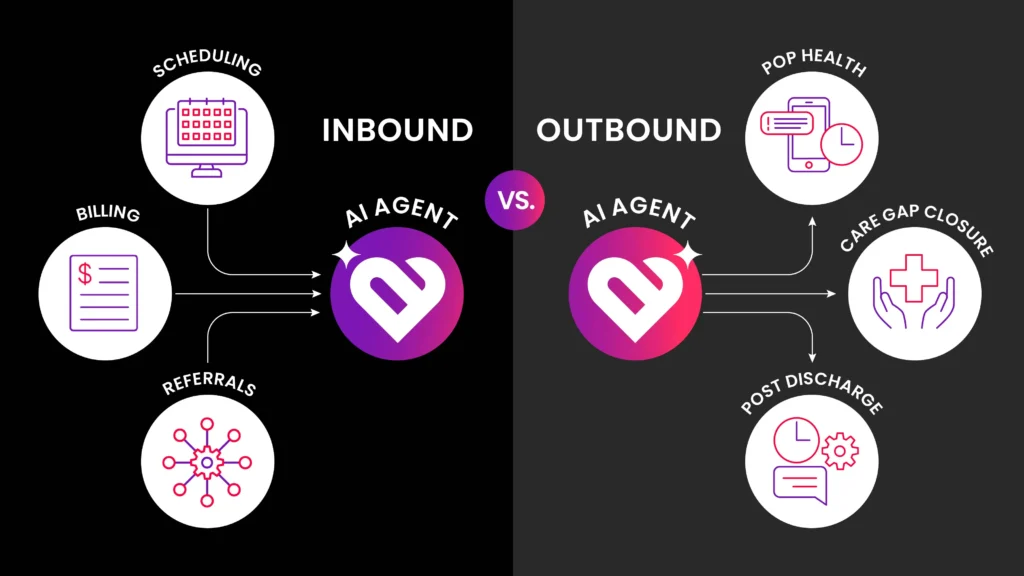
However, a successful AI strategy requires understanding that not all agents serve the same purpose. To truly transform patient engagement and operational efficiency, health systems must deploy both inbound and outbound agents strategically.
Defining the AI Agent Landscape for the Heathcare Industry
Before comparing inbound and outbound strategies, it’s vital to understand how the AI voice agent in healthcare has evolved with advancements in agentic AI. Modern Voice AI agents operate with fully autonomous reasoning.
Autonomous Agents leverage generative AI to handle non-linear conversations. If a patient pivots from asking about a prescription to asking about parking, an autonomous agent can handle the context switch seamlessly.
By integrating these agents into the Electronic Health Record (EHR) and existing telephony stacks, healthcare organizations can achieve massive efficiency gains. Data indicates that implementing these virtual agents can lead to a 72% reduction in staff time spent on phone-based tasks.
Inbound Voice AI: The 24/7 Digital Front Door
Inbound agents are your reactive defense line. They handle incoming calls from patients who need immediate assistance. For most healthcare providers, high-volume, low-complexity tasks overwhelm call centers that tie up staff and frustrate patients. Inbound Agents are meant to tackle these by primarily automating administrative workflows. We like to think of these as your AI “Patient Service Reps.”
A Primary Use Case: Scheduling and Patient Access
The most immediate ROI for inbound voice AI is scheduling. Patients expect to book, reschedule, or cancel appointments at their convenience, not just between 9:00 AM and 5:00 PM.
An inbound scheduling agent can verify a patient’s identity, look up real-time availability in the EHR, and book the slot. This capability is critical for “new patient” acquisition, ensuring that if a potential patient calls after hours, they are captured immediately rather than being forced to call a competitor the next morning.
Here are other examples of inbound use cases:
Password Reset
Automating password reset requests helps patients access their accounts without delays, reducing frustration and decreasing the burden on support staff. A digital agent can guide users through identity verification and securely reset credentials.
Billing
Patients can inquire about their billing statements, request invoices, or clarify charges using automated systems that pull real-time financial data. This ensures transparency and expedites the resolution of payment questions.
Test Results
Providing patients with secure, automated access to their test results fosters engagement and trust while reducing the need for manual follow-ups. Notifications and explanations can also help patients interpret their results.
Referrals
Digital tools can manage referral requests by validating insurance details, finding the right specialists, and scheduling with available providers, streamlining a traditionally time-intensive process.
Rx Management
Automated prescription refill systems can check eligibility, submit refill requests, and notify patients once the medication is ready, improving adherence and reducing lags in treatment continuity.
Insurance Verification
AI agents can guide patients through real-time insurance eligibility checks by accessing payer data via EHR integrations. This reduces coverage confusion, lowers claim denial rates, and improves the experience for new patients navigating plan details.
Pre-Visit Instructions and Prep
Inbound agents can automatically provide pre-visit instructions based on appointment type, such as fasting guidelines, what to bring, directions, or links to digital forms. This improves care preparedness and reduces appointment delays or cancellations.
Waitlist Management and Cancellations
When patients call to cancel, inbound agents can offer alternative slots or suggest joining a waitlist. This maximizes slot utilization and shortens the time to care, while reducing the administrative load on staff.
Language Support and Multilingual Access
Voice AI agents can communicate in the patient’s preferred language, improving access for non-English speakers. This helps healthcare providers deliver equitable experiences and reduces miscommunication that leads to delays or dissatisfaction.
Clinic and Provider Navigation
Patients often call unsure of which department or provider to reach. Inbound agents can gather context, answer common questions, and route calls to the correct destination, improving first-call resolution and minimizing patient frustration.
Response Handling for Outbound Campaigns
If a patient calls in after receiving an automated outreach message, inbound agents can recognize the context and assist accordingly. For example, the agent might confirm eligibility for a wellness visit and proceed with scheduling in real time.
Smarter Routing and Triage
Not every call can be solved by AI, and that is by design. Inbound agents act as intelligent filters. By accurately capturing the patient’s intent, whether it’s a clinical question, a billing dispute, or a prescription refill, the agent can route the call to the exact right human resource, passing along the context of the conversation. This “warm handoff” reduces the cognitive load on staff, who no longer have to start from scratch with a frustrated patient.
Outbound Voice AI: Proactive Care and Revenue Protection
Think of outbound agents as the outreach team that never sleeps. Rather than waiting for patients to call, these agents reach out, prompt screenings, schedule wellness visits and recover overdue appointments. Automated outreach helps hold down costs, protect revenue and close care gaps at a scale manual outreach cannot match. We like to think of these as your AI “Case Navigators.”
Value-Based Care and Population Health
For health systems moving toward value-based care (VBC), outbound AI agents are indispensable for closing care gaps. Manual outreach for screenings and wellness visits is expensive and difficult to scale. AI agents can manage thousands of calls simultaneously to drive specific initiatives.
The Annual Wellness Visit (AWV) Opportunity
Consider the Medicare Annual Wellness Visit. Beneficiaries are eligible for one AWV every 12 months (after their first year of Part B coverage). These visits are crucial for attributing patients to the health system and capturing Hierarchical Condition Category (HCC) codes.
However, scheduling them is a logistical heavy lift. An outbound AI agent can:
- Identify eligible patients who haven’t had an AWV in the past 12 months.
- Call them to explain the benefit.
- Schedule the appointment directly into the EHR.
- Even begin the required Health Risk Assessment (HRA), which can take up to 20 minutes, collecting demographic and psychosocial data before the patient ever walks through the door.
Other Outbound Voice AI Use Cases
Population Health Follow-Up
After identifying patients in need of preventive services or monitoring, an outbound AI agent can reach out to schedule screenings, vaccinations, or routine check-ups, ensuring better compliance with population health initiatives.
Post-Discharge Care Management
The agent can contact recently discharged patients to confirm they understand their discharge instructions, schedule follow-up appointments, and identify any concerns, reducing the likelihood of readmissions.
Chronic Disease Management
For patients with conditions like diabetes or hypertension, the AI agent can remind them to schedule routine labs, refill prescriptions, or engage in health coaching sessions, leading to improved disease control and outcomes.
Perioperative Education
Prior to surgery, outbound calls can provide patients with preparation instructions, answer common questions, and ensure they are ready for their procedure. This proactive communication helps reduce preoperative no-shows and enhances surgical outcomes.
Preventive Screenings Outreach
Outbound agents can identify patients who are due for screenings such as mammograms, colonoscopies, or flu shots. They can then reach out with personalized reminders and help schedule appointments. This supports population health goals and improves care gap closure.
Medication Adherence Support
Voice AI agents can follow up with patients after new prescriptions are issued to confirm pickup, provide guidance, or assist with refills. Consistent outreach reduces medication abandonment and helps manage chronic conditions more effectively.
Social Determinants of Health (SDOH) Outreach
For patients flagged with social needs, outbound agents can connect them to relevant support services such as transportation, housing, or food assistance. These proactive touchpoints help reduce care delays and improve overall health outcomes.
Behavioral Health Engagement
Patients enrolled in behavioral health programs can receive check-in calls, session reminders, or medication alerts. Outbound agents support continuity of care and encourage participation in mental health and substance use treatment plans.
Medicaid Redetermination Reminders
When patients are at risk of losing coverage due to Medicaid redetermination cycles, outbound agents can send timely reminders about deadlines and help navigate the process. This ensures ongoing care access and minimizes disruption in treatment.
Clinical Trial Recruitment and Reminders
Health systems can use outbound Voice AI to identify and contact eligible patients for clinical trials. Agents can explain the study, answer common questions, and help schedule screening visits. Ongoing reminders improve participation and compliance.
Wellness Program Promotion
Outbound agents can promote health system wellness offerings such as smoking cessation, nutrition coaching, or fitness classes. Engaging patients with these services enhances preventive care efforts and supports long-term health improvement.
Supporting the Patient Journey: Balancing Efficiency and Empathy
The integration of voice AI agents is not about replacing human connection; it’s about saving human connection for the moments that matter. By deploying inbound agents to solve immediate patient access problems and outbound agents to drive proactive health outcomes, health systems can achieve the “quadruple aim”: better outcomes, lower costs, improved patient experience, and improved clinician experience.
As you evaluate your digital roadmap for the coming year, consider where the friction lies in your patient journey. Whether it’s a clogged phone line on Monday morning or a list of 5,000 patients overdue for screenings, there is likely a voice AI agent ready to take the call.
Want to hear Artera’s AI Agents in action? Check out our audio demo samples here.
Voice AI in Healthcare: Key Questions for Health System Leaders
1. How do inbound and outbound Voice AI agents impact patient access and retention?
Inbound agents enhance patient access by handling high-volume administrative tasks like scheduling and password resets, while outbound agents proactively drive appointment adherence, follow-up care, and wellness visit completion. Together, they reduce friction in the care journey and help health systems retain patients who might otherwise disengage.
2. What operational ROI can health systems expect from implementing Voice AI agents?
Health systems using Voice AI agents have reported reductions of over 70% in staff time spent on phone-based workflows, with measurable improvements in no-show rates, care gap closures, and patient satisfaction. Artera’s platform also enables seamless EHR integration, further amplifying efficiency and data fidelity.
3. How are autonomous Voice AI agents different from traditional IVR systems?
Unlike static IVR menus, autonomous Voice AI agents leverage LLMs and Natural Language Understanding (NLU) to interpret intent, manage non-linear conversations, and complete transactions like appointment scheduling or Rx refills. This creates a far more natural, scalable, and context-aware patient interaction model.
What are high-impact use cases for outbound Voice AI in value-based care models?
Outbound Voice AI agents are ideal for driving Annual Wellness Visit compliance, chronic care management follow-ups, post-discharge outreach, and health risk assessments. These interventions support quality measures, reduce readmissions, and help health systems meet value-based reimbursement goals.
How does Artera ensure compliance and data security for Voice AI deployments?
Artera’s Voice AI agents are built with a best-in-class InfoSec approach, meeting SOC 2 Type 2, HITRUST, and HIPAA requirements. No PHI or PII is used in model training, and all workflows are governed by healthcare-specific compliance controls, ensuring enterprise-grade security and trust.
Can Voice AI agents triage and escalate complex patient inquiries effectively?
Yes. Artera’s inbound Voice AI agents perform smart triage by identifying clinical vs. non-clinical requests and routing to the appropriate human resource with full context. This “warm handoff” reduces staff burden while maintaining a high-quality patient experience.
How do Voice AI agents integrate with EHR and telephony systems?
Voice AI agents from Artera integrate directly with leading EHRs via HL7, FHIR, and API protocols, enabling real-time scheduling, eligibility checks, and data writebacks. Integration with existing telephony stacks ensures agents can operate within your current infrastructure without disrupting workflows.