What’s Happening to Healthcare SaaS?
Healthcare is at a crossroads. The demand for better patient experiences, lower administrative burden, and scalable automation has collided with rising costs, staff burnout, and inflexible legacy tools. At the same time, advancements in artificial intelligence, particularly AI agents, are transforming what’s possible in software.
SaaS (Software as a Service) has long been the delivery model of choice for healthcare systems buying digital tools. But not all SaaS is created equal. As expectations shift toward intelligent automation, the next wave of healthcare SaaS must be smarter, safer, and more connected.
This isn’t just a feature race. It’s a total shift in how we think about care, patients, admin and outcomes. We’re no longer talking about tools that sit passively in the background. Todays, hHealthcare SaaS must act, quickly and intelligently. It must understand intent, operate across systems, make real-time decisions, and support clinicians and patients alike.
That’s why now is the time for healthcare organizations to move beyond static platforms. The future belongs to SaaS platforms that incorporate AI agents. We’re proud to help shape that future.
What Are AI Agents in SaaS?
AI agents are software programs that use artificial intelligence to understand context, make decisions, and carry out tasks on behalf of users. In the SaaS world, and especially in healthcare, these agents are transforming passive tools into intelligent systems that take action without constant human input.
Unlike traditional SaaS features that depend on users navigating dashboards or submitting forms, AI agents work quietly in the background. They engage with patients, route tasks, update records, identify urgent issues, and complete multi-step workflows across systems.
These agents are built for autonomy. They are goal-oriented, meaning they can pursue defined outcomes without step-by-step instructions. They are context-aware, drawing insights from EHRs, scheduling platforms, billing systems, and patient messages. And they operate across multiple systems through APIs, allowing them to orchestrate workflows rather than just respond to single inputs.
For example, an AI agent might:
- Recognize a patient’s request to reschedule, check provider availability, and confirm a new time
- Transcribe a voicemail, detect keywords that indicate clinical risk, and escalate to a nurse
- Analyze patterns in communication and flag patients who may need follow-up
These are not surface-level automations. They reduce administrative burden, improve efficiency, and support better patient experiences while respecting the safety, accuracy, and compliance requirements of healthcare.
So, Is SaaS Dead in Healthcare?
No, SaaS isn’t dead in healthcare. But it is rapidly evolving.
Healthcare SaaS is moving away from basic, passive tools and toward intelligent platforms powered by AI agents. These modern systems automate repetitive tasks, personalize patient experiences, and manage complex workflows. They are no longer limited to simple CRUD operations like Create, Read, Update, and Delete. Instead, it’s offering adaptive assistance that responds to real-world context.
This shift brings both opportunity and responsibility. On one hand, AI-powered SaaS can improve outcomes, boost efficiency, and reduce administrative strain. On the other hand, it requires strong safeguards to ensure security, compliance, and patient trust.
Why the “SaaS is Dead” Discussion Even Exists
The idea that SaaS is “dead” comes from a growing reality: AI agents are rapidly replacing the old way software worked.
AI Agent Disruption
AI agents are taking over routine CRUD functions. Older SaaS models that simply store or display data are falling behind fast.
Beyond Simple Tools
Software can no longer just hold data. It has to act on it intelligently and autonomously.
Changing Expectations
Healthcare teams and patients are demanding better experiences, faster support, and less friction. Static portals and clunky dashboards no longer meet the moment.
Why SaaS Is Actually Thriving (and Evolving) in Healthcare
Despite the dramatic headlines, SaaS is far from obsolete in healthcare. In fact, it is undergoing a long-overdue transformation, and we are part of that change.
Addressing Core Issues
Modern SaaS platforms are tackling long-standing problems like compliance challenges, inefficient workflows, and administrative burnout.
Market Growth
The healthcare SaaS sector continues to grow. AI-powered platforms are expected to accelerate that growth, especially in response to staff shortages and rising complexity.
AI Integration
Artificial intelligence is evolving SaaS into something new. Instead of passive systems, we are seeing dynamic platforms that assist in real time and adapt to changing needs.
Specialized Solutions
General tools cannot address healthcare’s regulatory and operational complexity. That is why vertical-specific HealthTech SaaS, including agent-powered tools, is gaining traction.
The future of healthcare SaaS is not just about adding smarter features. It is about creating intelligent systems that think, act, and adapt alongside care teams. These platforms go beyond task management to become active partners in delivering better healthcare.
Intelligent Platforms
Expect software to shift from passive data storage to proactive, AI-driven platforms. These tools will interpret patient signals, anticipate needs, and help teams stay one step ahead in the care journey.
Security and Compliance by Design
With greater automation comes greater responsibility. Trust will depend on transparent design, real-time observability, and strong safeguards built into every layer of the product.
Outcome-Based Value Models
As software begins to deliver measurable results such as fewer missed appointments, reduced call volume, or faster response times, pricing models will evolve. The shift will move from user-based licensing toward models that reflect real-world impact.
Interoperability at the Core
Smart systems must work together. From EHRs to payer platforms and scheduling tools, future-ready SaaS must connect across the healthcare ecosystem to unlock true efficiency and value.
This evolution is already in motion. Healthcare SaaS is becoming more modular, more personalized, and more responsive to the complexity of care delivery. Organizations are seeking tools that do more than communicate. They want systems that coordinate workflows, surface insights, and adapt to the realities of clinical and operational demands.
From workflow automation and team augmentation to real-time communication and actionable analytics, the next generation of solutions is built to flex, scale, and support care teams in meaningful ways. Some tools will serve staff directly. Others will operate in the background, powering smarter patient interactions and helping leaders make informed decisions faster.
Why Healthcare Needs AI Agents Now
We do not need more software. We need better outcomes. AI agents are uniquely equipped to help us achieve them.
The Problem
Healthcare is overwhelmed. Clinical and administrative demands are colliding with workforce shortages and growing patient expectations.
Doctors spend seven hours on documentation for every eight hours of care
Administrative complexity wastes over $265 billion each year
Call centers are inundated with simple requests like appointment changes or billing questions
Nearly 50% percent of healthcare workers report burnout
Traditional software has not solved this because it was not designed to. It was built to store information, not act on it.
The Opportunity
AI agents step into that gap with clear value.
They can:
Automate routine workflows like scheduling, form delivery, and follow-ups
Transcribe voice conversations into structured clinical documentation
Identify clinical risk and escalate when needed
Communicate with patients twenty-four hours a day in multiple languages
Route messages to the right team instead of a generic inbox
This is already happening.
- Artera Flows Agents have powered more than forty two million patient sessions
- 94% of those were completed without staff intervention
- That equals over two hundred fifty thousand hours saved annually
But that is only part of the story.
AI agents are now being deployed across access, operations, and analytics. They support staff, enhance communication, and connect systems.
AI Across the Patient Communication Platform
Artera’s patient communication platform delivers intelligent tools that meet healthcare organizations where they are. Whether you are just beginning with automation or ready to adopt fully autonomous agents, Artera provides a connected, flexible, and scalable approach to improving staff efficiency, streamlining patient engagement, and ensuring consistent communication across systems.
Harmony Co-Pilot Agents
Support your staff with real-time AI assistance
Harmony Co-Pilot Agents are embedded directly into staff workflows, giving frontline teams a faster, smarter way to manage high message volumes and multitask more efficiently. These agents provide features such as real-time message translation, sentence rewriting, automatic summarization, and AI-assisted response suggestions.
For example, if a patient sends a long message with multiple questions, a Co-Pilot Agent can generate a concise summary and pre-draft a helpful response, allowing the staff member to review and send it with confidence. Co-Pilot Agents are designed with human oversight in mind, helping teams work smarter without sacrificing control or empathy.
Flows Agents
Automate structured, rules-based communication with confidence
Flows Agents are intelligent virtual assistants built on predefined logic and natural language understanding. They are ideal for automating routine conversations like appointment confirmations, directions, form collection, or billing FAQs.
These agents respond accurately to patient intent and escalate immediately when a request falls outside their scope. For example, a patient might ask, “Can I reschedule my appointment?” The Flows Agent can recognize the request, check eligibility, and return available times, without involving your staff. Because these agents follow structured workflows, they are safe, predictable, and highly effective for handling high-volume administrative tasks.
AI Agents (Voice and Text)
Deploy autonomous agents that take action across the care journey
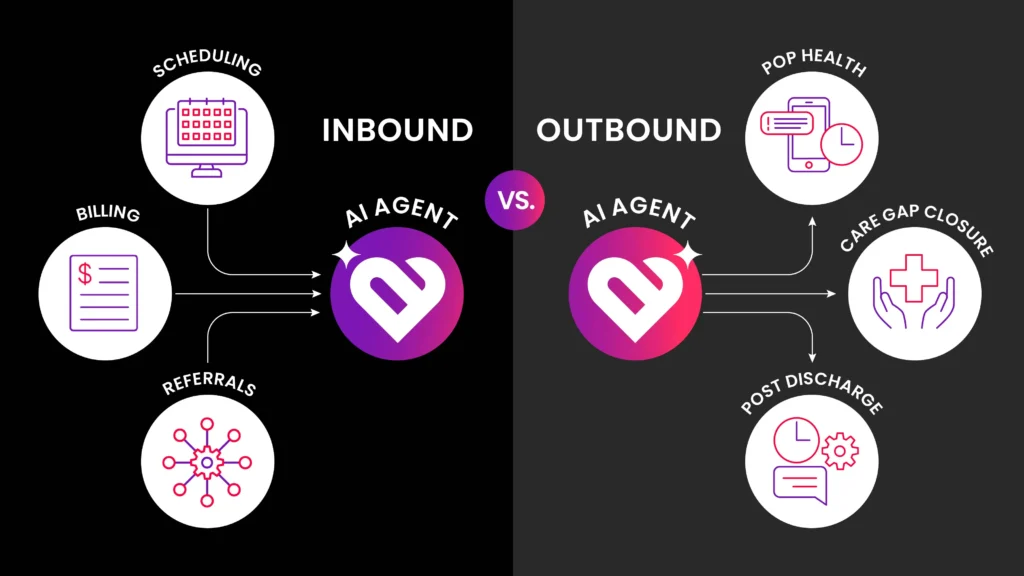
Artera’s fully autonomous AI Agents operate across both voice and text channels, handling complex, multi-step workflows from start to finish. These agents are goal-driven, context-aware, and capable of making real-time decisions based on information from EHRs, scheduling systems, and communication history.
They support interactions such as rescheduling an appointment, following up on a missed payment, or closing a care gap. For instance, if a patient leaves a voicemail saying, “I need to move my follow-up appointment to next week,” the AI Agent can transcribe the message, confirm identity, check provider availability, and send a new appointment time, all without staff intervention.
These agents are equipped with built-in escalation protocols, ensuring safety and compliance at every step. When a message contains risk indicators or unclear intent, the system automatically routes it to a human with full context.
Branded Messaging
Build patient trust with messages that look and feel familiar
Artera enables healthcare organizations to send messages that patients can recognize and trust. Every message includes verified sender details, organization branding, secure links, and rich previews that make it easy for patients to identify the source and feel confident engaging.
This approach reduces the chance of messages being missed, ignored, or mistaken for spam. It also improves engagement by making communication feel official and consistent. Whether the message comes from a staff member or an AI agent, Branded Messaging ensures it reflects your organization’s identity and maintains a professional, patient-centered tone.
Analytics and Insights
Turn engagement data into smarter decisions
Artera provides a robust suite of analytics tools to help teams understand how patients are interacting with outreach efforts. With dashboards, customizable reports, and AI-powered recommendations, staff can identify which messages are working, which are not, and how to improve outcomes.
For example, if a campaign to reduce no-shows at one location is underperforming, analytics can pinpoint where drop-off occurs and suggest changes to language or timing. Insights like these allow for continuous optimization and better resource allocation.
Artera ScheduleCare
Let patients book and manage appointments anytime
ScheduleCare gives patients 24/7 access to scheduling tools, reducing the need for manual intervention. Patients can confirm, cancel, or reschedule appointments on their own, and manage waitlists through dynamic links sent via text.
This lowers call volume, reduces the likelihood of missed appointments, and frees up staff to focus on more complex tasks. The experience is fast, secure, and aligned with patients’ increasing expectations for self-service.
Artera Intake and Payments
Streamline check-in and improve financial communication
With digital intake and payments, patients can complete forms, submit documents, and pay copays before they arrive. For example, a pre-visit message can include a link to update insurance details, sign a consent form, and make a payment, all from their mobile device.
This not only reduces waiting room bottlenecks, but also improves data accuracy and lowers the risk of missed payments.
Marketplace Integrations
Connect your existing systems with Artera’s open ecosystem
Artera offers seamless and safe integration with EHRs, scheduling tools, billing systems, and third-party platforms. Through the Artera Marketplace, healthcare organizations can connect their existing tech stack to support coordinated workflows and real-time data exchange.
For instance, when a referral is initiated in a care coordination tool, Artera can send a text to the patient with next steps, while syncing the outcome back to the EHR. These integrations ensure that communication is part of a continuous, connected experience.
Why Artera’s AI Agents Built for Healthcare Are Truly Different
We are not chasing hype. We are building something that lasts. We call it Agentic AI – designed specifically for healthcare, with safety, compliance, and human oversight at the core.
| Feature | Artera Agents | Generalized AI Chat |
| Rule-Based Workflows | Yes | No |
| Hallucination Risk | Very Low | High |
| Staff Escalation | Built-in and configurable | Often missing or unclear |
| EHR Integration | HL7v2, FHIR, Flat File, SFTP, Custom Development | Limited or generic |
| HIPAA Compliance | Certified and audit-ready | Not guaranteed |
| Human Oversight | Core principle with “human-in-the-loop” | Optional or absent |
| Purpose-Built for Healthcare | Yes | No |
| Deployment Model | Modular, scalable, and EMR-integrated | One-size-fits-all |
| Security Architecture | Designed for healthcare from the ground up | Varies, often retrofitted |
Unlike generic AI answering systems, our agents are tailored for healthcare and engineered to deliver meaningful outcomes without compromising compliance or patient safety.
Why You Should Not Buy SaaS Without AI Agents
Most healthcare organizations buy their software rather than build it from scratch. So the real question is:
Are the tools we are buying smart enough for today’s challenges?
Legacy SaaS requires constant human input. It stores data, routes forms, and adds clicks to your workflow.
AI-native SaaS listens, reasons, and acts. It understands patient language and automates workflows with minimal intervention.
Before you commit to your next vendor, ask:
Does this system include AI agents that actually reduce your team’s workload?
If the answer is no, you are buying outdated technology.
The Future Is Not Just More Automation. It Is Smarter Automation.
AI agents are not silver bullets. But when thoughtfully designed, they are powerful tools that lighten the load without compromising trust.
At Artera, we are not experimenting with AI for its own sake. We are building a clear path from rules-based automation to agentic intelligence, with safety, compliance, and human oversight at every step.
Because healthcare does not just need more software.
It needs intelligent systems that integrate, adapt, and support the real work of care delivery.
It needs SaaS that is ready for the next decade, not stuck in the last one.
Ready to Future-Proof Your Patient Communication Platform
You don’t need to rip and replace to move forward. The future of healthcare communication is modular, intelligent, and built to scale with your organization. Whether you’re beginning with structured automation or ready to deploy fully autonomous agents, the right partner makes all the difference.
Artera delivers integrated solutions that meet you where you are, and take you where your organization needs to go.
Let’s move toward smarter, safer, and more connected care.
Get a Demo.