Artificial intelligence is reshaping how healthcare organizations operate, from streamlining administrative tasks to improving patient engagement. Yet, as these technologies advance, so do the complexities of maintaining compliance. In an industry where trust is paramount, utilizing AI requires more than just innovative features; it demands a rigorous, proactive approach to security and privacy.
As healthcare providers adopt AI-powered tools, the question of data safety moves to the forefront. How do we ensure patient information remains secure while leveraging the speed and efficiency of AI? At Artera, we believe that compliance is not a barrier to innovation but the foundation upon which sustainable healthcare technology is built.
The Evolving Challenge of AI Compliance
Traditional healthcare compliance frameworks were designed for a different era. Regulations like HIPAA established essential ground rules for protecting Protected Health Information (PHI), but they were created long before the rise of generative AI and Large Language Models (LLMs).
Today, “agentic AI,” systems that can act independently to perform tasks, introduces new variables into the compliance equation. Unlike static software, AI models learn, adapt, and generate new content. This dynamic nature creates specific risks that standard security assessments might miss if they are only looking at a snapshot in time.
Healthcare leaders must now navigate three critical areas of concern:
Data Containment
This involves ensuring sensitive patient data never leaks into public AI models.
AI systems must be designed so that sensitive patient data, such as names, medical history, insurance information, or clinical notes, never leaks into public or third-party AI models. This risk increases when generative AI tools are trained on large datasets without proper safeguards. To remain HIPAA compliant, all data inputs and outputs must stay within secure, controlled environments. Healthcare organizations need to ensure that vendor platforms maintain full separation between customer data and the models that power the AI.
Spillage Prevention
We prevent data from one patient interaction from crossing over into another.
AI must treat every patient interaction as isolated and confidential. Without strong technical boundaries, AI systems may inadvertently carry information from one patient conversation into another. This kind of data spillage creates significant privacy risks and undermines patient trust. In healthcare settings, even a minor cross-reference of information can result in HIPAA violations or clinical missteps. Preventing this requires strict session isolation and carefully managed context controls at every level of the AI architecture.
Hallucination Mitigation
We also ensure the AI generates accurate, factual responses rather than misleading information.
Addressing these challenges requires a partner who understands that compliance is an active, continuous discipline, not a one-time checkbox.
When an AI model generates inaccurate or fabricated responses, the risk to patients and providers increases. These errors, often referred to as hallucinations, can include incorrect appointment times, misunderstood instructions, or false medical guidance. In healthcare, there is no room for guesswork. Preventing hallucinations involves validating AI outputs against real-time, source-of-truth data, continuously monitoring model behavior, and ensuring that all responses are grounded in verified information.
A Multi-Pillar Approach to AI and Security
Relying on a single certification is no longer sufficient in the age of AI. While frameworks like HITRUST are foundational, they often cannot keep pace with the rapid evolution of AI technologies on their own. That is why Artera employs a comprehensive, multi-layered security strategy.
We view certifications as pieces of a larger puzzle. Each one demonstrates a specific commitment to protecting your organization and the patients you serve.
The Certifications That Matter
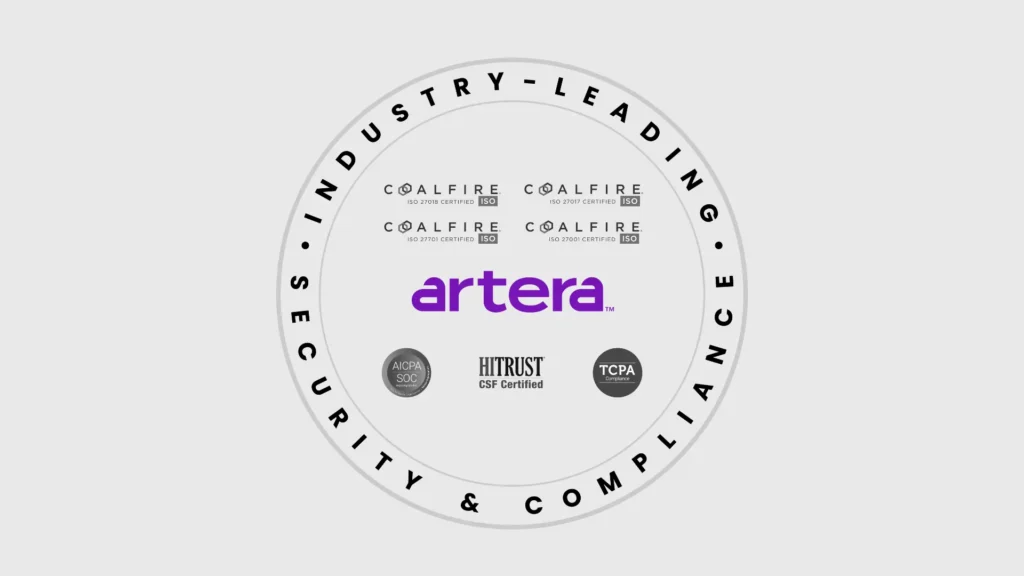
To provide complete peace of mind, Artera maintains a robust portfolio of industry-leading certifications:
HITRUST
This serves as the foundational layer for healthcare compliance, demonstrating our unwavering commitment to safeguarding PHI.
SOC 2 Type II
This third-party audit validates our internal controls regarding security, availability, processing integrity, confidentiality, and privacy over an extended period.
ISO 27001
The global standard for information security management systems, providing the bedrock for our security operations.
ISO 27701
An extension of ISO 27001, this certification specifically covers privacy management, ensuring we handle personal data with the utmost care.
ISO 27017 & ISO 27018
These certifications address cloud-specific security and the protection of Personally Identifiable Information (PII) in cloud environments, respectively.
By maintaining this diverse array of certifications, we ensure that every angle of your data’s security, from general management to specific cloud protocols, is covered.
Pursuing the Highest Standards
Our commitment extends beyond the private sector. Artera is currently pursuing FedRAMP High authorization, one of the most rigorous security baselines available for cloud services. Achieving “in process” status for FedRAMP High signals our dedication to meeting the stringent requirements necessary to handle highly sensitive government data. This pursuit elevates our overall security posture, benefiting all our clients by adhering to the strictest federal protocols.
Tackling AI-Specific Risks Head-On
Certifications validate our infrastructure, but our product engineering directly addresses the unique behaviors of AI. We have designed our platform to mitigate the specific risks associated with agentic AI, ensuring that efficiency never comes at the cost of safety.
1. Ensuring Data Containment
One of the biggest fears regarding AI is the potential for sensitive data to be used to train public models. At Artera, we implement strict Data Loss Prevention (DLP) measures.
We view this as a partnership between technology and people. Our technical controls create a secure environment where sensitive data remains separate from general AI processing. Simultaneously, our workforce undergoes rigorous training on AI best practices, ensuring that the human element of security is just as strong as the digital one.
2. Preventing Data Spillage
In a busy healthcare environment, keeping patient records distinct is critical. AI agents handling multiple conversations must never inadvertently mix data between sessions.
Artera utilizes a Model Context Protocol that creates strict boundaries for every interaction. This protocol dictates exactly what information an AI agent can access at any given moment. It ensures that a conversation with Patient A never accesses, references, or retains data belonging to Patient B. This compartmentalization is vital for maintaining HIPAA compliance in an automated environment.
3. Mitigating Hallucinations
In healthcare, accuracy is not optional. An AI model that “hallucinates,” or invents facts, about appointment times or preparation instructions can have serious consequences for patient care.
To combat this, we employ “Judge LLMs.” These are specialized models tasked with simulating conversations and evaluating our AI agents in real-world scenarios. They test agents, analyze interactions, and score performance to identify potential inaccuracies before they reach a patient. This proactive validation ensures that the information delivered is reliable and safe.
Building a Culture of Security
Technology and certifications are essential, but the true strength of a compliance program lies in the culture of the organization. At Artera, security is a core business principle embedded in everything we do.
Our dedicated Privacy and Security teams oversee the use of all personal information and PHI. They work hand-in-hand with product development to ensure that privacy is “baked in” to our AI products from day one, rather than added as an afterthought. This includes:
- Developing AI-specific internal policies.
- Conducting regular model assessments.
- Maintaining a strict inventory of all AI models in use.
- Encrypting data both in transit and at rest.
- Implementing role-based access controls so only authorized personnel can access sensitive data.
We also extend this scrutiny to our partners. Customer data is never shared with unaffiliated third parties—only with vetted vendors who have signed comprehensive contracts related to security and privacy.
Trustworthy AI Compliance in Healthcare: Secure Partnerships that Scale
As the healthcare industry continues to leverage AI, the landscape of compliance will inevitably shift. New threats will emerge, and regulations will evolve. This future requires a partner who is not just keeping up but setting the pace.
Healthcare providers need vendors who prioritize a “defense in depth” strategy, combining traditional certifications like HITRUST with innovative, AI-specific safeguards. By choosing a partner committed to transparency and continuous improvement, you protect your organization’s reputation and, most importantly, your patients’ trust.
At Artera, we are dedicated to making healthcare number one in customer service without compromising on safety. If you are ready to see how secure, compliant AI can transform your patient communications, we invite you to learn more about our commitment to trust.
Visit the Artera Trust Center to see how we protect what matters most.