Healthcare providers seeking to leverage agentic AI must first focus on infrastructure, interoperability, and governance to fully realize the benefits, as emphasized by the expert panel during the healthsystemCIO webinar, “Maximizing Value, Minimizing Risk: Operationalizing an Agentic AI Strategy.”
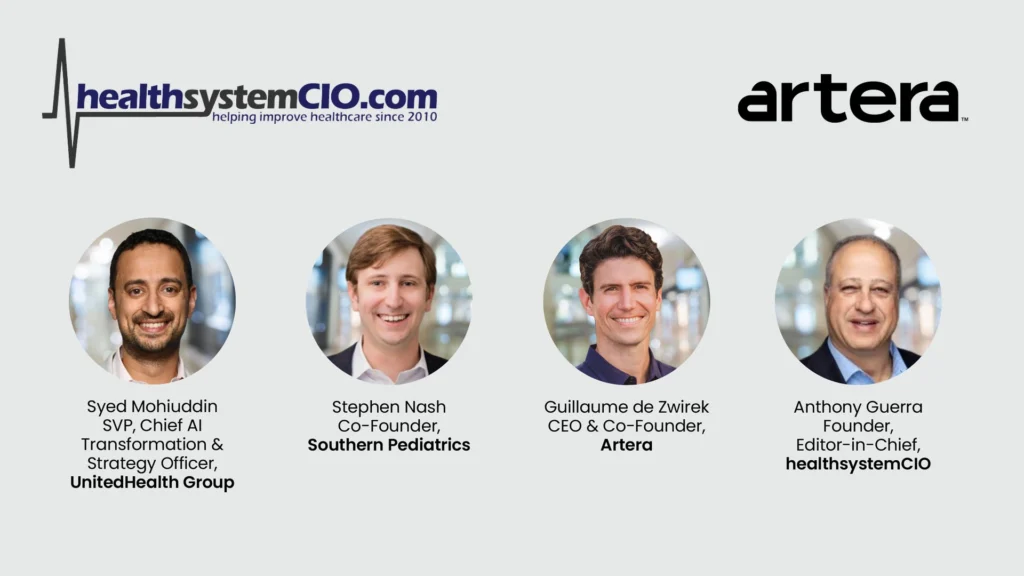
The discussion featured insights from industry leaders:
- Syed Mohiuddin, SVP and Chief AI Transformation and Strategy Officer, United Health Group
- Stephen Nash, Co-Founder, Southern Pediatrics
- Guillaume de Zwirek, CEO and Co-founder, Artera
Moderated by Anthony Guerra, founder and editor-in-chief of healthsystemCIO, the panel explored the practical realities of deploying agentic AI, from high-level strategy to on-the-ground implementation. The discussion provides a roadmap for organizations attempting to optimize resources and achieve operational improvements without increasing headcount.
The Strategic Imperative for AI Agents
The panel agreed that the adoption of AI is no longer optional; it’s existential. De Zwirek noted that AI will fundamentally rewrite technology investments across healthcare. The primary driver is the need to solve persistent problems, such as administrative waste, clinician burnout, and disjointed patient communication.
Nash emphasized this point, stating that the goal should not be to deploy agents for their own sake, but to address “burning pains” within an organization. For his pediatric practice, this means tackling challenges in charting and patient communication.
Most of these early AI opportunities are concentrated around high-frequency, high-friction workflows.
In large enterprises, Mohiuddin noted, the scope for agentic AI extends to administrative and clinical domains alike. Agents can be designed to not only provide “explanations” of past events (such as claim denials or benefit questions) but also to execute “actions,” such as guiding users through next steps or supporting claims processing. These applications help reduce the processing time for tasks like care-gap outreach and benefit alternatives, moving population health initiatives forward at much greater speed and scale.
De Zwirek described practical success in using AI to reach large patient populations and drive high rates of successful scheduling. This would reduce weeks-long processes into a matter of seconds, further illustrating AI’s potential as a force multiplier.
Governance and Interoperability as Gating Factors
Scaling AI in healthcare requires discipline akin to workforce management rather than iterative software trials. Mohiuddin stressed that successful deployment depends on rigorous frameworks for governance, design, and observability, paralleling the thoroughness involved in hiring, onboarding, and monitoring new staff. Leaders must fully understand what their agents are tasked with, institute controls for their activities, and monitor performance continuously.
De Zwirek reinforced the necessity of preemptive risk reduction, designing real-time evaluation systems and drawing on best practices from AI-driven software development, where architecture and review processes are central to preventing errors from affecting workflows at scale.
Perhaps the most critical challenge to real-world implementation is interoperability. As the panel noted, even when vendors partner closely with health systems, integration often remains the customer’s responsibility, especially in fragmented provider landscapes. Agents need reliable, timely access to EHRs, practice management systems, and downstream platforms to be effective. De Zwirek’s experience highlighted why Artera invested in building robust internal integration capabilities, and cautioned that pursuing full in-house development is only viable for organizations with significant scale and resources.
Mohiuddin added that both “speed to start” and “speed to completion” matter; often, success hinges on the last mile of integration. Leaders should treat agentic AI initiatives as vital strategic investments tied to organizational priorities, competitive advantage, and the specialized needs of their teams.
Leadership, Workforce Readiness, and the Human Element
Technology alone isn’t enough. The panelists reminded listeners that successful AI adoption demands strong leadership, transparent communication, and cultural readiness. Nash advocated for clear internal messaging that connects new tools to tangible outcomes, supporting staff in understanding how AI solutions translate to less administrative overhead and more meaningful time with patients.
Workforce preparation is equally crucial. Mohiuddin recommended formal, hands-on training for leaders and technical teams so they move beyond awareness to genuine fluency. Broad-based education helps surface governance needs and inspires safe experimentation, positioning organizations to identify both opportunities and risks.
Webinar Takeaways for Healthcare IT and Application Leaders
Interoperability and data accessibility are prerequisites for success
Agentic AI’s utility is limited by an organization’s ability to connect systems and deliver timely data.
Start with high-friction, high-impact workflows
Workflows such as documentation, messaging, scheduling, and care-gap management are solid places to start. This is where outcomes are measurable and value is quickly demonstrated.
Establish governance at a level that matches operational risk.
Invest in robust evaluation, monitoring, and controls before agents move into production.
Plan for the last mile
Whether integrating tools, adapting workflows, or managing organizational change, realize that internal effort is required in parallel with any external partnership.
Build broad-based AI fluency and align adoption with staff and patient outcomes.
Invest in training, encourage open knowledge sharing, and keep a sharp focus on benefits to clinicians and patients alike.
The message is clear: AI-driven automation offers health systems a path through resource constraints and operational complexity, but optimization requires bringing together the right processes, technologies, and people. As de Zwirek urged, now is the time for healthcare leaders to learn, experiment, and help move the industry forward by sharing lessons and building momentum beyond early adopters.
To view the recording of this webinar, Maximizing Value, Minimizing Risk: Operationalizing an Agentic AI Strategy (Sponsored by Artera), please click here.