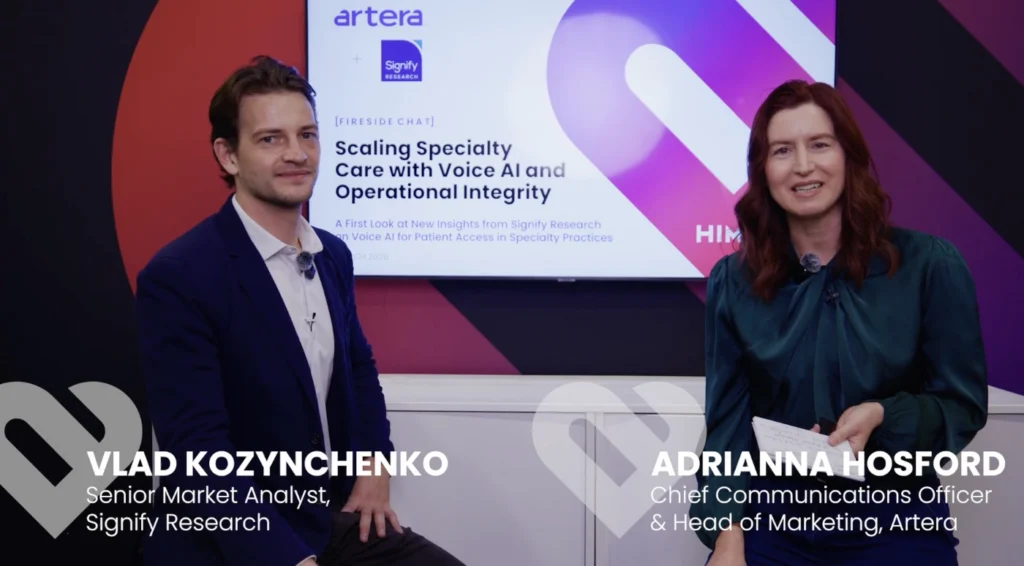
Welcome so much to Artera. We are so excited to have you today at the booth. We have an amazing conversation for you today. We are gonna share a sneak peek of some exciting research from Signify. The person behind that research is Vlad Kosachenko. Please introduce yourself and tell us about your company.
Awesome. Lovely to meet you all. Thank you for tuning in. My name is Vlad. I’m a senior market analyst at Signify Research. We’re a health tech, med tech focused market intelligence firm that essentially works with health care IT vendors in trying to identify opportunities in the market of where to play and how to win. And we’ve been engaged in this project with Artera to try and understand how specialty groups within the US health care system are approaching evaluation and adoption of patient access voice AI technologies.
Awesome. Thank you so much. We’re so excited to have you. I’m Adriana. I lead marketing and communications at Artera.
We have been in business for over ten years. Our company serves about a thousand customers, which you know, and we recently just won best in class, which is pretty phenomenal for us. But today, we’ve been hearing a lot from our customers and prospects and people in the field about how AI is just everywhere Right. And they don’t know how to decipher what’s hype versus what’s reality.
It’s part of why we partnered with Vlad and Signify is we wanted to fund some research to really look into how do these health care providers understand what’s genuine and and what’s not. So I know you did some research on our behalf. You’re looking at voice AI for patient access. Please walk us through it.
In terms of specialty practices, all of them have very similar issues. Right? They all are having sustained volume of high inbound calls. They have scheduling complexities, which you also see in larger health care providers.
They have increased patient expectations for immediacy due to the very consumer focused nature of healthcare within the US system. And last but not least, there is a very crowded marketplace, as you’ve said, with so many different vendors claiming that they can do the exact same thing. And so how do you distinguish between those that are actually doing meaningful work versus those startups that can deliver? And so we decided to start a project, speaks to a variety of specialty groups within the US healthcare system.
And so we surveyed groups from two seventy five sites, from sixty provider groups all the way up to six fifty providers working for the organization across different specialties focused on dermatology, orthopedics, ophthalmology, as well as a multi specialty environment. And within the interviews we assess what kind of KPIs they measure for access technology, inbound versus outbound value in terms of patient access, integration requirements for different vendors, risk thresholds, as well as of course the ROI, one of the most important questions. And throughout these conversations, we’ll try to identify what are the preferences between the inbound and the outbound capabilities for Voice AI for patient access.
And as you can see, inbound are basically answering the calls that are coming to the organization. Outbound is you’re proactively reaching the patients to perhaps confirm appointment, recall campaigns, no show reductions, things of that nature. Within the research, we have found that the specialties challenges can be absorbed into four categories, broadly speaking. Volume and capacity constraints.
Again, volume of calls, they need to deal with it, they need to have access staff at all times available, which is not physically possible. People need to have holidays. Workflow and scheduling complexity, there is provider specific requirements, there is insurance verification burden. It’s a lot more complex in large specialty groups and those challenges need to be addressed by a patient access technology vendor that has the capacity in terms of technology to do that.
Next one is patient readiness variability. We have different types of patients with different types of conditions, comorbidities and things of that nature. So we need to make sure different elder patients are catered in a productive manner the same way a younger patient might. Some may prefer text, some may prefer calls.
We need to make sure there is the omnichannel engagement available. And last but not least, there’s reliability and operational friction. So latency or system inconsistency is a big issue. Message is not properly logged or routed.
Escalation errors, all of those create frictions within the healthcare provider organizations that they need to deal with. And how do they deal with or how do they measure how to deal with those types of solutions? And again, it can be split into four different distinct categories. So the first one is volume and throughput efficiency.
So actually logging total call volume, calls handled per hour, average transaction time, access conversion and outcomes. So what’s the conversion rate? What’s the scene to schedule rate? Responsiveness and service level.
How quickly and reliably are patients being held? And last but not least is the experience and quality signals. So NPS, compliant volume, things of that nature. Having said that, throughout the discussions with all different healthcare providers, we realized none of them are tracking all of those metrics and they are extremely important.
So when choosing a partner, you need someone who enables you to be able to track all of those metrics across. One of the more common ones we’ve come across is seem schedule rate being monitored as well as the NPS service. But things like calls handled per hour were monitored only in a very small subsection of the respondents group, which is obviously not great. But at the same time, the evaluation of the voice AI for patient access technology is switching from did it reduce workload to can we attribute measurable lifts across these four dimensions depending on which one organization does track.
And my recommendation is for your specialty provider is to track all of them because that’s the way you’re gonna be able to assess whether the technology is doing the job it should be.
I have a couple questions for you on this slide and on the previous one. Yes.
So in these four categories, when your team was conducting these interviews Yeah.
Was it very clear to the providers you spoke to that these were the four categories they were evaluating, or did you sort of pull this out based on the discussions? I’m wondering how much awareness folks have when they’re evaluating vendors.
Absolutely. Folks have absolutely no awareness. Right? So we synthesized all of the results, pulled the results out to showcase to people what they actually should be, you know, combining across all of the different specialties that we’ve seen.
Some organizations don’t track any of them. Some organizations track eighty percent of them. But those are the most common metrics we’re seeing being tracked across all of the provider interviews we have done. And then we’ve bucketed them together into four categories, four domains if you will, that provide a great level of understanding and detail of how useful patient access voice AI technologies actually are.
That’s interesting. One of the areas that we’re coming across a lot with customers and with prospects is most of them are looking for a solution that can reduce call volume.
Yeah.
So just one bullet Right. Out of the thirty bullets you have here.
Hundred percent. Hundred percent. A a lot of the customers also say NPS. Some don’t even track call volume.
Right? For them it’s more about outcomes. What’s the seem to schedule rate? Right? Especially when you’re trying to do follow-up calls or you’re trying to do outbound volume.
You know, you received the message, you got left a voice note, a voice mail, you need to respond to that within a twenty four, forty eight hour period. But because you have small teams responsible for calling out patients and it’s all done manually right now, they don’t get to the patients on time. And if you’re gonna make the patient wait for forty eight or more hours, guess what? They’re gonna switch to a different specialty group because within specialties it’s extremely competitive in terms of trying to bring in money.
Right? So a lot of the metrics that were focused were outcome based, but at the same time they didn’t track it necessarily in a structured manner.
So a lot of the providers and specialty groups and clinics that we speak to Yeah.
Just as you noted are under pressure to produce very quick results Right.
When they have new voice AI, which is part of the reason why I think folks are so focused on reducing call volume. In a dream scenario for you, what would you recommend that a specialty group or clinic look at when they’re thinking long term to measure success of a new product like this?
That’s a fantastic question. I feel like first you need to establish the base. You need to be tracking KPIs as is to then see if there is a meaningful uplift in the when you’re gonna adopt the PatientVoice AI technology. Right?
Because if you’re not measuring the before to compare it to the after, you’re not necessarily gonna know how great the technology has been working for you. So I think the first step is establish the KPIs you really care about and track them before implementing the Voice AI technology. Many organizations already do that and hopefully your partner will also enable you to track that uplift as you integrate them to see, you know, what was the reduction in no shows? What the cancellation rate increase or decrease depending on what the optimal metrics are?
Right? And so I feel like first, you need to understand the metrics you want to measure and you want to have outcall, inbound and outbound improvement.
And then partner with an organization that’s going to enable you to consistently track that uplift. But we will go in a second as well in one of our slides to show how providers currently are approaching assessment and evaluation of Patient Access Voice AI technologies within the broader sense. And first though, I want to highlight the adoption reality that’s actually happening across all the specialty groups. When we’re talking about integration, it’s very complex as there is not a single layer and so any new vendor trying to come on board with a provider or specialty group needs to think about their existing foundations within telephony, with a clinical system of record, digital communication layer, and last but not least, the AI augmentation layer.
And so the biggest element is being able to integrate with the provider’s existing technology stack because they’ve already spent a significant amount of money on, for example, SMS outbound and they wouldn’t necessarily want to switch everything all at once. Maybe it’s going to be a phased approach. And so patient access voice AI technology needs to be able to be flexible with the providers in adapting to each individual specific preferences and stacks. I think that’s the interesting one in terms of the ROI credibility ladder.
Right? And so all of the specialty providers are essentially in the first three months are looking, are those KPIs we’ve been tracking, are they getting lifted? Well, if you haven’t tracked them in the beginning, how do you actually know they are being lifted? So it’s so important to track them in the first three months just to see are you making progress.
Within the three to six months, you start to see is the solution reliable. You start paying attention to things like accuracy, how it does with complex cases, does it do warm handoffs well to make sure there is no major patient complaints, right? Then within the six to twelve months, that’s when everyone expects an ROI. Across all of the conversations, they’re expecting Staffing Impact to be qualified within the six to twelve months and be a net positive for their organizations, being able to measure the cost savings versus the total cost of ownership, performance lift attribute and the ROI narrative.
And then last but not least, and that’s what many providers really miss, is, is it going to be a sustainable decision in the future twelve months from now, right? Is it going to have a stable performance over time? Is it going to have degradation in experience? Because so many organizations within patient for access voice AI technologies are great to per early signals, right?
They do a great demo, they do a great pilot, but when you scale that and you interact with the complexities of healthcare system with a provider of six fifty plus physicians, all of which will have different varying preferences for the way they want to get scheduled, but how long those will be. The logic within the EMR, right? And a lot of organizations will do well within the zero to three months, but then fail miserably looking twelve months and beyond. And so as a provider, you really need to be looking not only in the beginning, but also towards sort of the twelve month mark plus.
Yeah, this is a great framework.
Actually. When I saw this slide, I really liked it because to your point, this could be a framework that providers could use to think about not only to reach those first few goals of, like, that pressure, how do we reduce call abandonment, how do we get good feedback from staff, but then making sure that the solution you picked last beyond implementation and really drives value long term, not just in kind of your first three months, but really long term. So I think this could be a great framework for specialties and clinics looking to try to understand what should I look for for a vendor, how do I pick the right solution for me.
Hundred percent and that actually positions us really well for the next slide, which looks what is it that specialty providers need from their vendors and they need to be consistent across these six core measurable dimensions. So scheduling, integrity at scale, as we were discussing earlier, you need to be aligned with provider specific rules, budget types, insurance constraints, things of that nature. Escalation by safety, safety by design. So again, warm handoffs, make sure you know when to call in a person rather than continuing the conversation with AI.
All of that needs to be seamless because otherwise you’re going get stuck in the zone of RPA which we had before, right? Press one to get to the and there you said twenty minutes on the call, not able to get to the person. And so that’s a really big challenge that needs to be solved by patient Access Voice AI vendors. Defensible performance lift.
Again, as measured, we need to know what happened before and what happened after integrating patient for Access Voice AI. What are the abandonment reductions, ROI improvements? Experience stability across demographics, mentioned again, but different age groups, different demographics have different preferences for the way they want to be communicated. Very often what happens is a patient will go to a provider, they will tell them the preferences.
I want to be texted instead of called. That information gets captured but not actioned. No one does anything with that. And so that needs to be changed to make sure you’re able to engage patients where they wanna be engaged without having to ask them twenty times what technology you’re using.
Unified operational intelligence. I think that’s a big one people under appreciate because AI here is not necessarily all gonna replace the FTEs that you’re hiring. Right? It needs to be a symbiosis between the two different groups and you need to be able to manage those two different groups together.
And so having unified operational intelligence which integrates the reporting between AI and the human workflows is super duper useful for the specialty provider organizations. And last but not least is the configuration agility and adoption durability. So ability to evolve scheduling logic depending on the provider wants. Maybe they change their templates, maybe the escalation pathways have been tested.
So that needs to be done as well to make sure you’re able to change things in time to make sure that the providers are happy and satisfied with their selection of vendor. One of the biggest problems I’ve been told again and again and again, we don’t have great customer support within our existing solutions. And that’s such a big issue because if you’re down and you’re only gonna get a response twenty four hours from now, you need someone to be there for you to help you because that’s lost revenue and as well know, healthcare is very thin on margins and you can’t really lose no money in that case.
We at Artera are obviously big believers in a lot of the concepts here. I mean, our messaging is even about how you combine humans and AI intelligence to solve patient communication problems.
And so this piece on a warm hand on and allowing AI to let staff work at top of their license Right.
Is just part of our mission and so critical to us. Do you think that that is an area that a lot of providers are thinking about yet of not replacing staff, but instead freeing them up so they can focus on real human interactions. Yeah. And then let the voice AI handle a lot of the administrative, predictable, repeatable work. Like, what are you seeing in these interviews?
Absolutely. So there are different types of staff within a health care provider organization. You have the call center staff, and then you have nurses, practitioners who are all doing supplementary work to the call center staff. And from my conversations, it’s split into two groups.
Right? Some want complete reduction of FTEs within the call centers. Others want to repurpose them for other activities. So it does really differ from organization to organization, provider to the provider.
But broadly speaking, everyone wants to reduce the full time employed staff because it’s greater ROI and they see patient access for voice AI technology as one way of doing that. Right? However, there is also another group that wants to upscale their workers they have right now and let AI handle majority of the calls. I remember clearly one of the organizations I asked, what would success look like to you?
They said no FTE staff at all. AI agents just do the whole thing. Again, technology wise, safety wise in terms of how comfortable the provider organizations will feel with it, I think we’re still early doors. But I see a future when five, ten years, the whole front door experience and outbound calls, I can see it all being automated by AI without necessarily having a need to have providers involved even five percent of the time.
I’m so appreciative that you did this work for us. Of course. It’s really fascinating. The other thing I’ll mention is this is just the beginning.
It it doesn’t include actually all of your insights. You still have more interviews that you’re doing. And then you’re going to be producing a white paper Yes. Which anyone can scan this QR code.
They can download the research themselves from Signify, and we were just really grateful that you allowed us to commission this, we appreciate you and your expertise and we’re always trying to find answers and offer education for specialty groups and clinics for all our healthcare provider customers.
So thank you so much for partnering with us and bringing these It’s been very interesting project.
I’m glad we partnered on this together.
Good. Thanks Vlad.
Thank you.