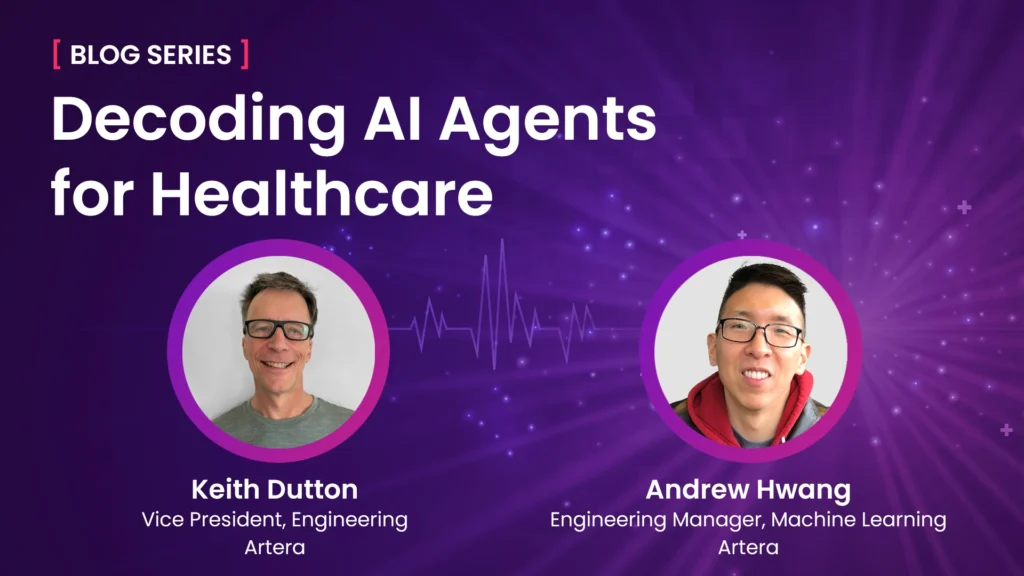
By: Keith Dutton, Vice President, Engineering, and Andrew Hwang, Engineering Manager, Machine Learning
When people think of AI agents, they often picture a powerful Large Language Model (LLM) that can handle tasks with just a simple “prompt.” But building effective AI agents for healthcare is a whole different ballgame.
These agents manage critical, multi-step workflows where the margin for error is virtually nonexistent. With incredibly high stakes, safety, accuracy, and stringent compliance are non-negotiable.
Consequently, developing production-ready, reliable and HIPAA-compliant AI agents for the healthcare industry not only demands advanced prompt engineering but a full ecosystem of solid backend tools, smart data pipelines, advanced analytics, and strict compliance frameworks. In this context, the prompt is really the foundation of a much bigger, highly connected system built to work seamlessly together.
Discover what truly differentiates enterprise-ready healthcare AI agents from consumer-grade solutions and why it matters.
What Specialized Prompt Engineering Is & Why It Matters
Language models are essentially rich repositories of information. Our goal with prompting them is to provide clear, precise instructions and guidance, ensuring they produce responses that align with our desired outcomes. It involves a full process of writing, refining and optimizing outputs.
Given the complexity of healthcare-related workflows, AI agents require explicit, highly structured instructions to successfully conduct natural conversations, all while adhering to strict safety and compliance guardrails. This is particularly critical in an MCP (Model Context Protocol) context where we craft prompts to support and leverage these complex instructions.
This meticulous approach enables agents to effectively handle ambiguous scenarios and complete entire workflows without skipping steps or fabricating information (aka hallucinations). Such considerations are fundamental to how we optimize agent prompts when developing our solutions.
Workflows like new patient appointment scheduling might seem like a simple conversation, but can actually be quite complex, involving numerous steps that can take more time than expected, like verifying a patient’s name, confirming insurance, reviewing appointment schedules, etc. If the agent fails at any stage of the conversation, the process falters, highlighting the significance of the explicitly detailed prompt itself.
Effective Prompt Engineering Techniques
Designing agentic AI for healthcare providers that’s safe and compliant involves a disciplined, multi-layered approach that integrates both technical expertise and strategic design. Below are some core techniques essential to the prompt engineering process:
1. Narrow Scope and Consistency to Create Reliable Healthcare Agents
For an agent to perform reliably in healthcare, it needs a clear job. For example, a scheduling agent should only focus on things like scheduling, rescheduling, or canceling appointments. This can include tasks such as verifying patient identity, checking provider availability, navigating location preferences, selecting appointment types, sending confirmations, managing waitlists, handling appointment reminders, and following up on missed or canceled visits.
When designers lay out exactly what an agent can and can’t do, it keeps the conversation on track. An overly broad prompt often yields unhelpful results from the agent.
2. Safety Guardrails to Prevent Hallucinations
Prompts must include explicit “do/don’t” instructions to enforce safety. For example, an agent might be told, “You are not a doctor; do not provide medical advice.” These constraints prevent agents from making clinical judgments, offering diagnoses, or answering questions that should be handled by licensed professionals. Additional guardrails may include restrictions around accessing or referencing sensitive data, such as insurance information, prescription history, or protected health details unless verified through appropriate tools.
Agentic prompts within the healthcare space are also designed to ensure agents handle ambiguous responses appropriately. If a patient answers a yes-or-no question with “maybe,” the agent knows to re-ask the question until it receives a valid answer, rather than making assumptions. In high-stakes workflows, such as confirming surgical prep or managing medication instructions, these safety protocols ensure the agent stays within approved parameters, escalating to human staff when needed.
3. Modular and Scalable Design
Writing a new, complex prompt for every customer or use case is inefficient. Instead, adopting a modular template system streamlines the process. A foundational “healthcare agent” template can include universal safety guardrails and ethical protocols, while a secondary “use case” template customizes the agent for specific workflows, such as scheduling or prescription refills. This approach ensures consistency while allowing for easy specialization.
Resist the urge to over-engineer agent prompts for a quick fix, as some vendors may throw everything into an agent prompt in service of quick implementation. While this might seem efficient for a fast go-live, it’s brittle and introduces risk. Whereas thoughtfully designed, intent-based MCP (Model Context Protocol) tools can increase performance, reduce the risk of hallucination and improve scalability.
4. Iterative and Flexible Prompts
Prompts must be designed for continuous refinement. A rigid or overly detailed prompt can lead to conflicts or unpredictable behavior. Modular, flexible prompts allow teams to quickly test and modify specific sections as needed without a complete rewrite. This iterative approach enables rapid improvements based on real-world feedback.
Measuring, Testing, and Improving AI Workflows
Testing and evaluation are critical to building reliable prompts. The process often begins by breaking down workflows from top to bottom into individual components and testing them in isolation. In simple terms: we have a goal of what the agent should be able to do from point A to point B, and so, how do we get it to point B?
Once these components are refined, end-to-end tests ensure they work together seamlessly.
For example, for a scheduling agent, you would break down the process into multiple pieces, or checkpoints: verifying patient information, identifying why the patient is calling in, recognizing which providers the patient can see, confirming eligibility, etc. In order to create a unified experience, we would need to make sure each step works in an isolated fashion before stitching them together to successfully book the appointment.
Think of It Like a Conversion Funnel
Once your AI agent is live, you need to keep a close eye on how it’s doing. This is where performance monitoring comes in. Think of observability dashboards as your mission control: they help you track important metrics, like how often the agent successfully completes a task, and pinpoint exactly where things might be going wrong.
You can essentially think of this example as a classic conversion funnel, where the patient comes in, and you have to go through all the checkpoints to complete scheduling. We’re always evaluating from this funnel perspective: is the agent doing what it wants? If not, where’s the drop-off, and how do we improve that?
For example, our team noticed that name recognition was lower than expected (many patients were falling off), so we improved the way our agent was able to recognize names through some backend engineering that interacts with the prompt. With the change, our success rate for name matching increased by 46.15% for patients already in the system.
Another necessary component to evaluating and maintaining the lifecycle of agents at scale is a technique called “LLM-as-a-Judge” or LAJ. LAJ systems sift through transcripts and call recordings and score conversations based on things like task completion, compliance & safety, workflow adherence, agent errors, and patient experience. This feedback is gold for making the agent even better and reducing the burden of human evaluation on a timely basis.
How Tools Enhance the Effectiveness of AI Agents
When we initially started building agents, we relied heavily on prompts to guide them. But we quickly learned that, instead, giving them the right tools is what really levels up the agent’s capabilities, helping it explicitly understand when and how to perform actions within the given context.
Tools enable agents to understand what actions to take in a given context without overloading prompts with excessive instructions. By abstracting actions into the form of tools, the process becomes less error-prone, as the agent can choose from a predefined set of tools based on the situation.
For instance, when looking up a patient, a tool is used to facilitate the process of retrieving the necessary information. These tools perform backend API calls and return only structured, relevant data to the agent. The system is designed to limit an AI agent’s knowledge to only what’s necessary, reducing errors and hallucinations. Limiting responses minimizes misinterpretations and errors, thereby ensuring users fully complete the intended experience.
Having the right tools in place means we don’t need as many explicit instructions directly in the prompt (aka we don’t need to over-stuff them). We’re moving towards tools like MCP handling more of the information, acting as communication nodes for the agent to complete workflows. This shift will continue as language models get better and faster, allowing us to integrate improved solutions.
Prompts & Tools Must Work Together
As AI keeps evolving, prompts are getting shorter as models get smarter and tools become more powerful. We’re already seeing improvements in how AI “thinks through” complex responses. Multi-agent systems are also on the rise, with specialized agents handling tasks like patient verification or scheduling appointments. This modular setup makes them faster, safer, and easier to build.
In the future, better security and compliance will let agents take on bigger jobs, like processing payments or other high-trust tasks. But the key to success stays the same: combining a specialized, compliant prompt foundation with a solid system of tools, metrics, and constant improvement. Prompt engineering is important, but it’s just one piece of the puzzle for building safe, reliable AI agents for healthcare.
Today’s healthcare market is saturated with AI agent solutions, making vendor evaluation difficult for healthcare providers amidst similar claims and significant costs.
To simplify your evaluation, we’ve identified the top five factors that distinguish Artera’s AI agents today. Whether you’re new to AI agents or well into your research for a partner, we hope this distillation proves valuable.
Artera’s blog posts and press releases are for informational purposes only and are not legal advice. Artera assumes no responsibility for the accuracy, completeness, or timeliness of blogs and non-legally required press releases. Claims for damages arising from decisions based on this release are expressly disclaimed, to the extent permitted by law.
AI in Healthcare – FAQs
How can I evaluate the best AI agent platform for healthcare?
When considering what the best AI agent evaluation platform for healthcare is, look for solutions built specifically for the clinical, operational, and regulatory complexities of healthcare. Avoid platforms that are retrofitted from general-purpose AI tools. Key criteria should include HIPAA compliance, validated EHR integration, real-time performance monitoring, and governance frameworks that ensure safety, accuracy, and transparency. Artera delivers a purpose-built platform with a modular agent design trusted by more than 1,000 healthcare organizations and federal agencies.
What makes AI agents in healthcare different from generic AI assistants?
Healthcare AI agents must operate under strict regulatory frameworks (like HIPAA), manage complex multi-step workflows, and interact with sensitive patient data. Unlike general-purpose chatbots, they require structured prompts, safety guardrails, integration with clinical systems, and ongoing monitoring to ensure safety, accuracy, and trust.
How does Artera ensure its AI agents are safe and compliant?
Artera agents are designed with a healthcare-first approach. We do not use PHI or PII in model training, and our agents operate within a secure architecture that meets SOC 2 Type 2, HITRUST, and HIPAA compliance. Every agent follows strict governance protocols, real-time monitoring, and human oversight where needed.
What is a Model Context Protocol (MCP), and why is it important?
A Model Context Protocol is a structured way to deliver instructions, context, and tools to an AI agent. Instead of relying solely on prompts, Artera uses MCP to modularize agent behavior, improving accuracy, scalability, and safety across healthcare workflows.
Why does prompt engineering alone fall short in healthcare AI?
Prompts can guide the behavior of an AI agent, but without guardrails, backend tools, and integration into clinical systems, they can produce unpredictable or unsafe responses. In healthcare, where the margin for error is near zero, tools and testing infrastructure are just as critical as the prompt itself.
How does Artera’s modular approach support scalability?
Artera uses a layered design: a universal base agent for healthcare safety and compliance, and customizable “use case” templates for workflows like scheduling, intake, and referrals. This approach allows organizations to scale quickly while maintaining control and consistency.
Can Artera AI agents integrate with our existing EHR?
Yes. Artera integrates with all leading EHRs and digital health tools using secure API, HL7, and FHIR standards. This enables real-time data exchange and smooth workflow execution across your digital ecosystem.
How does Artera prevent AI agents from hallucinating or going off-script?
We combine prompt engineering with tool-based constraints, backend validations, and real-time performance monitoring. Techniques like “LLM-as-a-judge” help us assess agent behavior at scale, ensuring adherence to clinical and operational standards.
How can I start evaluating AI agents for our organization?
Start by identifying high-volume, low-risk workflows that are currently manual, such as appointment scheduling or reminders. Artera’s team can help you assess AI readiness, map your workflows, and develop a safe rollout plan tailored to your compliance, staffing, and tech stack.