

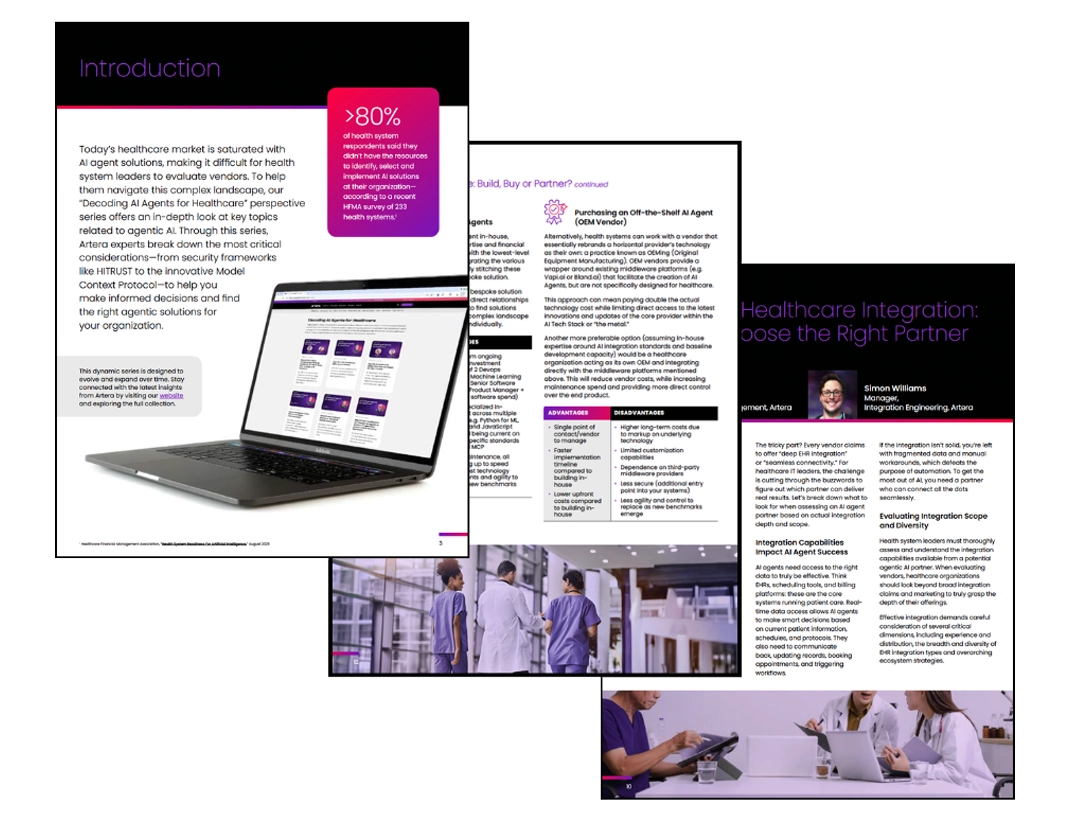
Healthcare leaders evaluating autonomous AI healthcare systems face three primary strategic options: build, buy or partner. This whitepaper outlines the operational, financial, and long-term risk tradeoffs associated with each approach, helping organizations align AI strategy with institutional capacity.
Agentic AI healthcare environments require layered architecture that addresses model evolution and structured access enforcement. Learn why standard certifications aren’t enough for dynamic, constantly evolving AI systems and explore advanced security measures that must be taken. This whitepaper provides a healthcare-specific security evaluation framework designed for AI deployments in clinical and operational environments.
Get a clear breakdown of Model Context Protocol. See how MCP creates secure, strictly defined boundaries for AI-system communication, preventing unauthorized data spillage and drastically mitigating the risk of AI hallucinations.
An AI agent is only as powerful as its connectivity. AI healthcare integration determines whether agentic AI delivers measurable efficiency or creates new silos. Uncover the core requirements for deep EHR integration, ensuring your voice AI agents healthcare tools can access the real-time clinical and scheduling data necessary to drive accurate, autonomous decisions.
Go beyond basic software uptime. Learn how to track the healthcare AI performance metrics that matter most to your operations, from latency and time-to-first-token to patient experience scores and workflow reliability. Organizations deploying healthcare AI agents without transparent performance metrics may lack production readiness.
Agentic AI in healthcare is evolving rapidly. Infrastructure providers update models frequently. Security threats adapt quickly. Regulatory scrutiny continues to increase.
Decisions made today regarding AI healthcare integration, governance and deployment strategy will shape operational resilience for years to come.
Healthcare organizations that approach agentic AI with architectural rigor will reduce administrative burden, improve patient access and enhance staff productivity.
Those that prioritize surface-level automation risk hidden costs and exposure.